Unitherm Insulation Systems

  • Home
  • Shop
  • Insulation Solutions
    • Plastics Equipment Insulation
    • Pipe and Valve Insulation
    • Passive Fire Protection
    • Freeze Protection and Material Handling
    • Exhaust Insulation
    • Marine Exhaust Insulation
    • Rigid Board Insulation
    • OEM
  • Applications
    • Aerospace
    • Data Centers
    • Defense
    • Exhaust Systems
    • Gas Compressors
    • Locomotive
    • Marine
    • Oil and Gas
    • On Highway
    • Power Generation
    • Reciprocating Engines
    • Turbines
  • Services and Capabilities
    • Custom Insulation Blankets, Jackets, and Covers
    • 3D AutoCAD
    • High Temperature Raw Goods
    • Custom Embroidery
    • WaterJet/CNC Machining
    • Private Labeling
  • Reseller Program
    • Reseller Locator
  • Blog
  • About
    • Contact
    • News
    • Customer Service
    • Order Now
  • Media
    • Documents
    • MSDS Sheets
    • Product Literature
    • Product Gallery
    • Video
    • Energy Study Library
    • New Customer Form
  • NPE 2027

November 3, 2026 by UniAdmin

Heat Trace vs. Insulation: Why You Often Need Both

Should you insulate a pipe or heat trace it? In many freeze-protection applications, that’s the wrong question. Heat tracing and insulation perform different functions, one supplies heat, the other conserves it. The thing that most engineers new to frost protection miss is that most reliable freeze-protection systems use both.

What Heat Tracing Does

Electric pipe tracing is placing an electrical resistance heating element parallel to the pipe. The heater provides heat to the pipe to balance heat loss to colder surroundings.

Several technologies can be used, including self-regulating, series, mineral-insulated, and zone heating cables. Each is suited to different application requirements, pipe lengths, and power considerations.

What Insulation Does

The pipe and tracing elements are then covered with thermal insulation. Insulation reduces heat loss from the system to the surrounding environment, allowing the heat-tracing system to maintain temperature more efficiently.

Insulation used in these applications must be protected from rain and external conditions with an appropriate weather barrier, since wet or damaged insulation loses its effectiveness.

Why Both Matter

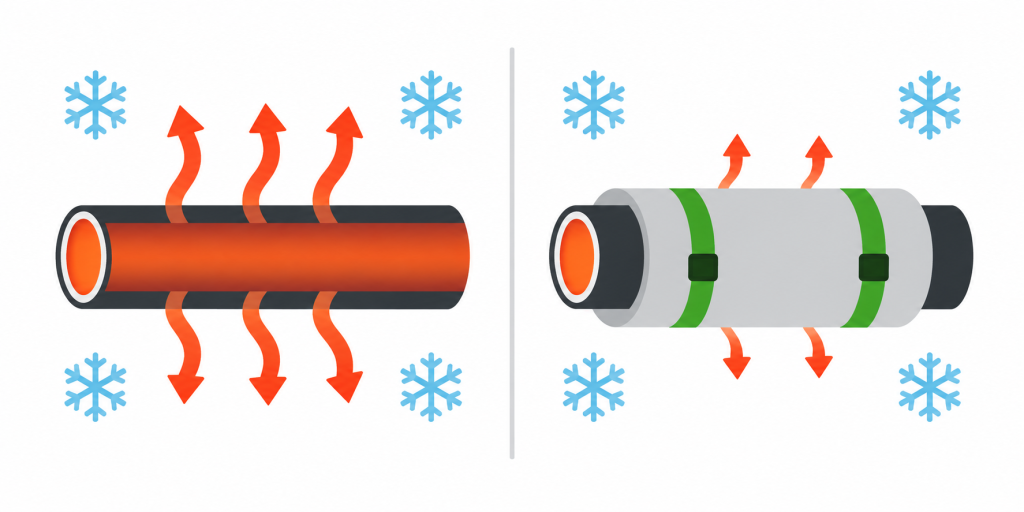
Consider a traced pipe without insulation. The heating system supplies energy, but heat can readily escape to the environment. The heat trace ends up working harder than it should, and may not keep pace in severe conditions.

Now consider an insulated pipe with no supplemental heat. The insulation slows heat loss, but it cannot continuously replace the energy being lost from stagnant fluid. Given enough time in cold conditions, the pipe still freezes.

Combining the two allows each technology to perform its intended function:

Heat trace: supplies heat.

Insulation: reduces heat loss.

Controls Matter Too

Heat tracing doesn’t necessarily need to operate at full output under every condition. ASHRAE notes that pipe-tracing systems are designed around worst-case heat loss at the lowest design ambient temperature. Controls can be used to reduce unnecessary energy consumption when conditions are warmer.

For example an ambient thermostat energizes the system as air temperature approaches freezing, rather than running continuously through winter regardless of conditions.

The appropriate control strategy depends on the application and heat-tracing system. The important takeaway is that freeze protection should be designed as a complete system, heat source, insulation, and controls working together, rather than as a choice between insulation and heat.

Building a Complete Freeze-Protection System

If you’re weighing insulation, heat tracing, or both for your piping, UniTherm can help you design a system sized to your actual heat-loss conditions and control strategy — not a one-size-fits-all fix. Contact our team to talk through your application.

This is week 6 of a 10 week series discussing the methods and science of frost protection systems. To learn more or to follow this series click this link: Subscribe to Updates

To find out more information on the frost protection offerings that Unitherm International can provide, go to shop.unitherm.com to view our full listing of products or email quote@unitherm.com to speak to a representative about custom solutions.
Filed Under: Freeze Protection Tagged With: electric pipe tracing, freeze protection controls, heat trace vs insulation, heat tracing and insulation, self-regulating heat cable

October 27, 2026 by UniAdmin

How Insulation Actually Protects Piping From Freezing

Insulation is one of the most important components of many freeze-protection systems, but its role is sometimes misunderstood. Insulators do not create warmth. They reduce heat transfer — and that distinction matters more than one might think.

Heat Naturally Moves Toward the Colder Environment

When the fluid inside a pipe is warmer than the surrounding environment, heat moves outward. Thermal insulation adds resistance to that heat flow, slowing (but not stopping) the transfer of energy from the pipe to its surroundings.

In mechanical insulation, ceramic fiber or insulation jackets can reduce the energy required by a heat-tracing system and extend the time to freezing if the system becomes idle or heat tracing fails.

More Insulation Can Extend Cooling Time

ASHRAE’s published freeze-time examples demonstrate the effect. Under the specific conditions used in its table, increasing the insulating material’s thickness raises the estimated time required for stagnant water to cool to freezing.

That doesn’t mean “more insulation always solves freezing.” It means additional thermal resistance slows heat transfer, buying time, not eliminating risk.

Insulation Cannot Supply Missing Heat

This is the critical limitation. If stagnant water continues losing energy to an environment below freezing, insulation alone cannot maintain the water temperature indefinitely.

Sufficiently long exposure to low ambient temperatures can eventually cause stagnant or insufficiently flowing water to freeze despite insulated pipes. Where conditions require it, supplemental heating can be added so that heat lost from the system is replaced.

That leads directly to one of the most important distinctions in freeze protection:

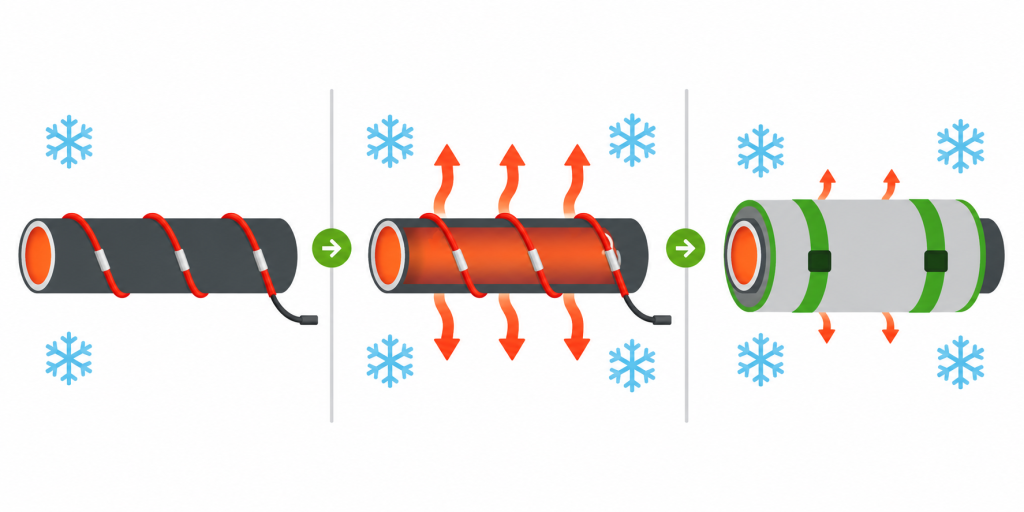
Insulation conserves heat. Heating systems supply heat.

Effective designs recognize the role of both. Insulation reduces how much heat a system needs to replace; heat tracing or another heat source supplies that heat so the fluid never has enough time to reach its freezing point in the first place.

Pairing Insulation With the Right Heat Source

Knowing where insulation alone is sufficient — and where it needs to be paired with a heating system — is a core part of freeze-protection design, not an afterthought. UniTherm can help you evaluate whether your piping, tanks, or instrumentation need insulation, supplemental heating, or both, based on your actual operating conditions. Contact our team to talk through your application.


This is week 5 of a 10 week series discussing the methods and science of frost protection systems. To learn more or to follow this series click this link: Subscribe to Updates

To find out more information on the frost protection offerings that Unitherm International can provide, go to shop.unitherm.com to view our full listing of products or email quote@unitherm.com to speak to a representative about custom solutions.
Filed Under: Freeze Protection Tagged With: freeze protection design, how insulation prevents freezing, insulation vs heat tracing, mechanical insulation ASHRAE, pipe insulation freeze protection

October 20, 2026 by UniAdmin

How Long Does It Take a Pipe to Freeze?

This question sounds simple: how long will my pipe take to freeze? Unfortunately, there isn’t one universal answer — freeze time depends on the specific conditions of the system, not a fixed number that applies to every pipe on site.

UniTherm provides a method specifically for estimating how long stagnant water in an insulated pipe takes to cool to 32°F. The calculation considers:

  • Initial water temperature
  • Ambient air temperature
  • Inside pipe diameter
  • Thermal resistance
  • Water density
  • Specific heat

A Useful Example

ASHRAE publishes a table showing estimated cooling times for different nominal pipe sizes and insulation thicknesses. The table assumes very specific conditions:

  • Initial water temperature: 42°F
  • Ambient temperature: -18°F
  • Insulation thermal conductivity: 0.30 Btu·in/h·ft²·°F

Under those assumptions, ASHRAE estimates the following cooling times to freezing:

Nominal Pipe SizeInsulation ThicknessEstimated Time to Freeze
2-inch1 inch~1.1 hours
2-inch2 inches~1.7 hours
2-inch4 inches~2.5 hours
6-inch1 inch~3.7 hours
6-inch2 inches~6.9 hours
6-inch4 inches~11.7 hours

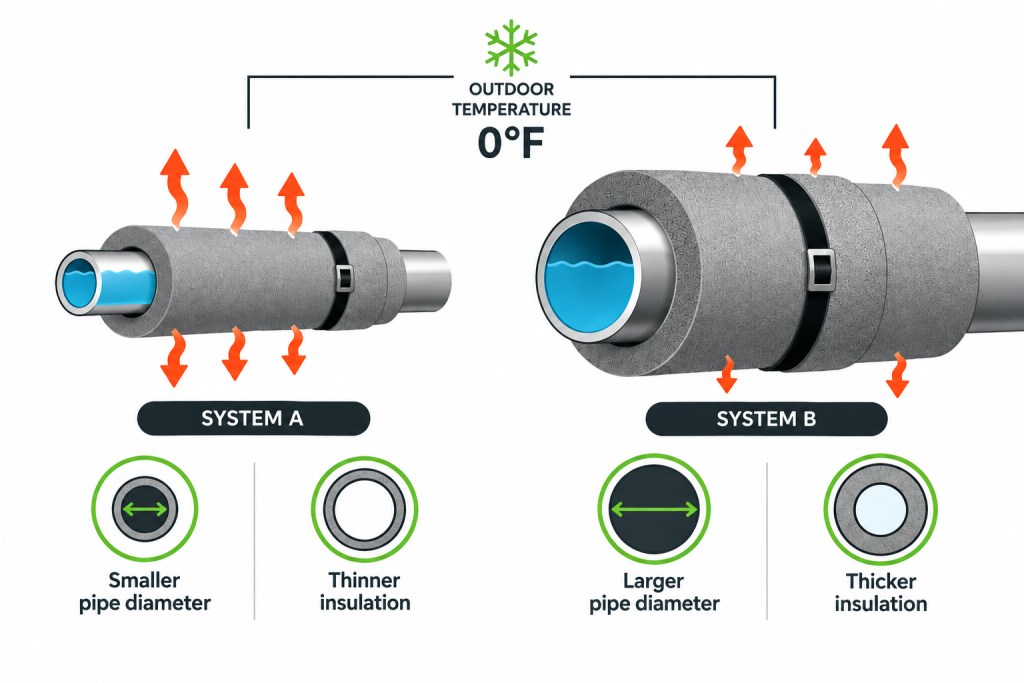
These are not universal freeze times. They apply only to the stated assumptions, and they’re most useful for illustrating how pipe size and insulation thickness affect cooling time — larger pipes with thicker insulation consistently take longer to reach 32°F under the same ambient conditions.

Cooling to 32°F Isn’t the Entire Freezing Process

Clean water may supercool before ice begins forming. Once nucleation occurs, additional heat — the latent heat of fusion — must leave the water as ice forms. Well-insulated piping can slow that process too, adding further time beyond simply reaching the freezing point.

This reinforces an important engineering point: “below freezing outside” and “frozen pipe” are not the same event. Time, temperature, pipe dimensions, insulation, and operating conditions all matter, and any one of them can shift the actual freeze time well beyond a rule-of-thumb estimate.

Use the Calculation, Not a Guess

ASHRAE’s table is a helpful reference point, but it isn’t a substitute for running the numbers on your own system’s actual pipe sizes, insulation, and design ambient temperature. If you need to know how much time — and how much protection — your piping actually has under winter conditions, UniTherm can help you work through the calculation for your specific application. Contact our team to get started.


This is week 4 of a 10 week series discussing the methods and science of frost protection systems. To learn more or to follow this series click this link: Subscribe to Updates

To find out more information on the frost protection offerings that Unitherm International can provide, go to shop.unitherm.com to view our full listing of products or email quote@unitherm.com to speak to a representative about custom insulation solutions.

Filed Under: Freeze Protection Tagged With: ASHRAE freeze time calculation, how long does it take a pipe to freeze, insulation thickness freeze protection, pipe cooling time, pipe freeze time

October 13, 2026 by UniAdmin

The 7 Variables That Determine Pipe Freeze Risk

The Variables That Determine Pipe Freeze Risk

There isn’t one number that tells an engineer whether an industrial pipe needs freeze protection. Freeze risk is the result of several interacting design conditions, not a single ambient-temperature threshold — which is why a proper freeze protection design starts well before anyone selects equipment.

Heat-tracing manufacturers begin their freeze-protection design processes by establishing those conditions first. Here are the variables that matter most.

1. Minimum Ambient Temperature

The greater the difference between the desired pipe temperature and the surrounding temperature, the greater the potential heat loss. The appropriate design ambient should reflect the actual location and application, not a generic regional low.

Outdoor air temperature isn’t always the relevant number. Piping in unheated buildings or unconditioned spaces can be exposed to freezing conditions at different minimum ambient temperatures than what’s happening outside.

2. Desired Maintenance Temperature

Freeze protection doesn’t necessarily mean designing exactly to 32°F. Different fluids and processes can require different maintenance temperatures. Highly viscous fluids may need to be maintained above their freezing temperature simply to retain the viscosity necessary for flow.

3. Pipe Diameter

Pipe dimensions influence both the amount of fluid contained within the pipe and the thermal characteristics of the system. Freeze-time calculation and commercial heat-tracing design procedures account for pipe size, since a larger volume of fluid relative to surface area behaves differently than a smaller one.

4. Pipe Material

Thermon and nVent both include pipe material among the information required during heat-tracing design. The correct design should be based on the actual piping construction rather than assuming all pipes behave identically — different materials conduct heat at different rates.

5. Insulation

Insulation type and thickness directly affect heat loss. ASHRAE’s pipe-tracing heat-load calculation includes the dimensions and thermal properties of the insulation surrounding the system, since insulation slows heat loss rather than eliminating it.

6. Flow Conditions

A flowing system can behave very differently from a stagnant one. ASHRAE specifically notes that sufficient flow can prevent freezing, because the available heat content of the moving water offsets the system’s heat loss. Stagnant or low-flow sections don’t have that same continuous heat source, which is why they carry disproportionately higher freeze risk.

7. Equipment and Supports

Straight pipe isn’t the entire system. UniTherm’s design process requires designers to account for valves, pumps, other equipment, and pipe supports when determining heat-trace circuit lengths.

Evaluate Freeze Risk as a System, Not a Single Number

The lesson across all seven variables is the same: freeze risk should be evaluated as a thermal system, not from ambient temperature alone. Minimum ambient, maintenance temperature, pipe size and material, insulation, flow, and equipment all interact to determine how — and whether — a given line freezes.

UniTherm designs freeze protection around these actual operating conditions rather than a single temperature threshold. If you’re evaluating freeze risk for piping, tanks, or instrumentation on your site, contact our team to walk through the variables specific to your system.


This is week 3 of a 10 week series discussing the methods and science of frost protection systems. To learn more or to follow this series click this link: Subscribe to Updates

To find out more information on the frost protection offerings that Unitherm International can provide, go to shop.unitherm.com to view our full listing of products or email quote@unitherm.com to speak to a representative about custom insulation solutions.

Filed Under: Freeze Protection, Uncategorized Tagged With: energy conservation, manufacturing, thermal insulation

October 6, 2026 by UniAdmin

Why Industrial Piping Freezes: It’s More Than Just 32°F

Water freezes at approximately 32°F (0°C) under ordinary conditions but that doesn’t mean every pipe on site freezes when the outdoor temperature drops to 31°F. Effective industrial pipe freeze protection depends on understanding what actually happens between “cold outside” and “frozen solid,” and that gap is where engineering judgment matters most.

There’s another critical variable at play: time.

A pipe and the fluid inside it hold thermal energy. When ambient temperature falls below fluid temperature, heat transfers from the warmer system toward the colder surroundings. This means the fluid’s temperature drops as that energy is lost. Freezing isn’t a light switch — it’s the end point of a heat-loss process that unfolds over minutes, hours, or days depending on the system.

The Variables That Determine Freeze Risk

Estimating how long stagnant water in an insulated pipe takes to cool to freezing accounts for several variables, including:

  • Initial water temperature
  • Ambient temperature
  • Pipe inside diameter
  • Water density
  • Specific heat
  • Thermal resistance of the pipe and insulation

With so many factors are involved, two piping systems exposed to the exact same outdoor temperature might behave very differently. Changing pipe diameter or insulation thickness, for instance, changes the thermal characteristics of the whole system. A larger volume of water retains more heat relative to its surface area, while thicker insulation slows how quickly heat escapes.

Fluid movement matters just as much. When sufficient flow is maintained, insulation can do its job retaining heat. This is because continuous water flow brings new thermal energy into the exposed section of pipe. Stagnant or insufficiently flowing water doesn’t have that same continuous heat source. Meaning dead legs, idle lines, and low-flow branches are consistently where freeze failures start.

Insulation Changes the Rate — Not the Freezing Point

It’s worth being precise about what insulation actually does. Adding insulation doesn’t change water’s freezing temperature. Instead, it increases resistance to heat transfer, which slows the rate at which the fluid loses heat to its surroundings.

Given enough time under sufficiently cold conditions, stagnant water can still freeze insulation alone buys time, it doesn’t guarantee protection indefinitely. That’s why engineers shouldn’t evaluate freeze risk based only on the question:

“Will the temperature fall below 32°F?”

A better question is:

“How much heat will this system lose under our design conditions, and how long can the fluid remain above its critical temperature?”

That perspective shift from a single threshold to a heat-loss and time calculation is the foundation of effective freeze protection.

Designing for Freeze Risk, Not Just Freeze Temperature

Freeze protection engineered around heat-loss variables holds up far better under real winter conditions than protection based on a single degree threshold. Whether that means sizing insulation correctly, specifying heat tracing for stagnant or low-flow lines, or identifying the dead legs most likely to fail first, the right approach starts with the math, not the thermometer.


This is week 2 of a 10 week series discussing the methods and science of frost protection systems. To learn more or to follow this series click this link: Subscribe to Updates

To find out more information on the frost protection offerings that Unitherm International can provide, go to shop.unitherm.com to view our full listing of products or email quote@unitherm.com to speak to a representative about custom insulation solutions.

Filed Under: Freeze Protection, Manufacturing, Safety, Uncategorized Tagged With: freeze protection, FreezePro® Frost Protection Systems, manufacturing

September 29, 2026 by UniAdmin

Freeze Protection: A Guide for Engineers and Maintenance Personnel

Freezing temperatures can create significant problems for industrial piping, valves, equipment, and the fluids moving through them. But effective freeze protection involves more than simply wrapping a pipe in insulation.

A properly designed system starts by understanding how heat moves from the fluid and piping system into the surrounding environment.

What Does Insulation Actually Do?

Thermal insulation limits heat transfer between a surface and its surroundings. In freeze-protection applications, this means slowing the rate at which heat leaves a warmer pipe, vessel, or piece of equipment and moves into colder ambient air.

While insulation does not generate heat, nor does it completely stop heat transfer. Insulation can extend the amount of time required for water to freeze. Prolonged exposure to cold temperatures can eventually freeze stagnant water even when the pipe is insulated, leading to cracks and bursts.

When Heat Is Required?

When natural fluid flow and/or insulation cannot provide adequate protection from freezing temperatures, it’s important to consider thermal heating methods.

One of the most common heating methods, and the method found in FreezePro insulation systems is heat tracing cable.

Traditionally Heat trace cable is wrapped around the pipe and secured with insulated blankets such as ceramic fiber blankets, however, FreezePro products combine the two for easy one step install.

The essential concept is that the two products are serving complementary functions;
the heat trace supplies the heat and the insulation retains the heat.

Regardless of how you choose to pair your heat trace and insulation combo, the essential concept is that the two products are serving complementary functions; the heat trace supplies the heat and the insulation retains the heat.

What Engineers Should Consider

Freeze protection isn’t as simple as the outdoor temperatures. There are many factors that can lead to frozen pipes and in turn, pipe damage. Here’s a list of a few thing any engineer should think about when creating a frost protection plan.

  • Pipe diameter
  • Pipe length
  • Pipe material
  • Minimum ambient temperature
  • Available electrical supply
  • Desired maintenance temperature
  • Startup temperature
  • Insulation type
  • Insulation thickness

Freeze Protection Is a System

The most useful way to approach freeze protection is therefore to look at the entire thermal system rather than one component. Engineers should consider the fluid, piping, equipment, insulation, environmental conditions, heat source when required, controls, and weather protection. When you understand the heat loss of a system you can then provide an adequate means of controlling it.

This is week 1 of a 10 week series discussing the methods and science of frost protection systems. To learn more or to follow this series click this link: Link

To find out more information on the frost protection offerings that Unitherm International can provide, go to shop.unitherm.com to view our full listing of products or email quote@unitherm.com to speak to a representative about custom insulation solutions.

Filed Under: Freeze Protection, Manufacturing, Uncategorized Tagged With: energy conservation, manufacturing

January 21, 2015 by UniAdmin

4 Common Misconceptions About Industrial Insulation

We come across many people who have the wrong idea about industrial insulation and think what we offer is not right for them. We ask them a few questions, and usually they are left wondering why they haven’t insulated their equipment sooner. We throw them a UniVest and they rush out the door to install it (cause it’s really that simple).

So we don’t have to go through the same spiel every time, we’ve compiled the most common misconceptions people have when it comes to industrial insulation.

1. Insulation is for my home, not my machines 

This is the most common one we come across and it’s pretty obvious why. The first thing people think about when you say insulation is their home and what’s inside their walls. That’s a perfect analogy because UniVests work the same way. Properly insulating your home saves you hundreds of dollars a year on home heating and cooling costs. It protects outside temperatures from affecting the temperatures you want inside. The easier it is for your home to maintain its temperature, the less you spend at the end of the month. UniVests are no different, except we deal with higher inside temperatures. Take a second and think, if you save hundreds by properly insulating your home, imagine how much could be saved when insulating your machine. We’ll give you a hint…its much greater!UniVest-3-Strap-On-Off-W-Background-Color

2. No Budget for Insulation

We all have budgets. Yeah, and we know they can be small and hard to deal with. Trust us, Windows 98 is getting really old at the office. Making new purchases on things that you are already operating without can seem like a luxury purchase. Little known fact is that with proper insulation, a company can see ROI (Return on Investment) in under 12 months. In the right conditions, a single set of UniVests or ISOCOVERS can last 5+ years after installed. That’s 5+ years of return. In 12 months or less, most companies make back the purchase price of a UniVest from energy savings alone.

3. My machines are working fine now without insulation

We’re sure they do, but wouldn’t you like for them to work better? Insulation minimizes the downtime of the machines they are on and relieves stresses from a hard working machine. This even increases the lifespan of the equipment. Wouldn’t we all like to work a little easier? Your machines would too.

4. Who Needs Protection AnywayIMG_8583

The biggest thing that people don’t realize is that insulation also improves workplace safety. As seen in a few of our videos on Youtube, a heated barrel with a UniVest on it can be touched and worked around without any special protective gear. More Safety = Less downtime and less liability. Insulation can also decrease surrounding ambient air temperature. Decreasing work fatigue due to high temperature and more comfortable work areas. 

Here’s typically the point where some people are kicking themselves for not already having insulation installed. If you didn’t make it this far, we completely understand. Our insulation systems are much more than the sum of their parts and offer a lot more usability than most people realize. If you’ve finally come to the conclusion that insulation could benefit you, take a look around our online shopping cart at www.shop.unitherm.com. For some help finding the product, measuring, or just want some more insulation entertainment like this blog, visit our youtube page: www.Youtube.com/UniThermInsulations

Filed Under: Energy Efficiency, Freeze Protection, From the Marketing Team, Manufacturing, Plastics Industry, Safety, Uncategorized Tagged With: cooling, education, energy, energy conservation, energy costs, energy efficiency, energy efficiency projects, energy management, environment, heating, industrial applications, industrial insulation, innovation, insulation, lean manufacturing, manufacturing, manufacturing industry, plastics, safety, thermal insulation, UniTherm, unitherm international

August 9, 2011 by Kendal White

What’s New at UniTherm International?

2011 has been an exciting year at UniTherm International! Over the last year, we’ve taken major strides in improving our facility and R&D capabilities, strengthening marketing efforts, and broadening our representative base. We’re pleased share a sneak peak inside UniTherm HQ to show you changes we’re making to improve our products and services.

Research and Development Updates

Using state-of-the art technology and equipment, UniTherm engineers are more focused on research and development than ever before. This year we’ve rigorously tested our products’ performance which has led to the release of new and improved models of FirePro, discovered new applications for UniVest and FlexWatt and even launched a new product, SolarShell.

SolarShell is a glass-reinforced, plastic laminate that cures and hardens when exposed to UV rays. Be sure to stay tuned for future SolarShell updates, as we’ll release a series of test videos for this multipurpose product later this summer. [Read more…]

Filed Under: Energy Efficiency, Fire Protection, Freeze Protection, SolarShell, UniTherm News Tagged With: Represent UniTherm, Research & Development, SolarShell, UniTherm

  • Español

Quick Links

MSDS
Product Brochures
Energy Study Library
Product Videos

Follow UniTherm

Facebook
Twitter
Blog
YouTube
Instagram
Pinterest

UniTherm Insulation Systems

711 Jones St.
Lewisville, TX 75057
Toll Free: 800.657.9542
Phone: 972.436.1401
Fax: 972.436.0112
info@unitherm.com

Copyright © 2026 · Executive Pro Theme on Genesis Framework · WordPress · Log in