Unitherm Insulation Systems

  • Home
  • Shop
  • Insulation Solutions
    • Plastics Equipment Insulation
    • Pipe and Valve Insulation
    • Passive Fire Protection
    • Freeze Protection and Material Handling
    • Exhaust Insulation
    • Marine Exhaust Insulation
    • Rigid Board Insulation
    • OEM
  • Applications
    • Aerospace
    • Data Centers
    • Defense
    • Exhaust Systems
    • Gas Compressors
    • Locomotive
    • Marine
    • Oil and Gas
    • On Highway
    • Power Generation
    • Reciprocating Engines
    • Turbines
  • Services and Capabilities
    • Custom Insulation Blankets, Jackets, and Covers
    • 3D AutoCAD
    • High Temperature Raw Goods
    • Custom Embroidery
    • WaterJet/CNC Machining
    • Private Labeling
  • Reseller Program
    • Reseller Locator
  • Blog
  • About
    • Contact
    • News
    • Customer Service
    • Order Now
  • Media
    • Documents
    • MSDS Sheets
    • Product Literature
    • Product Gallery
    • Video
    • Energy Study Library
    • New Customer Form
  • NPE 2027
You are here: Home / Blog

May 21, 2013 by Kendal White

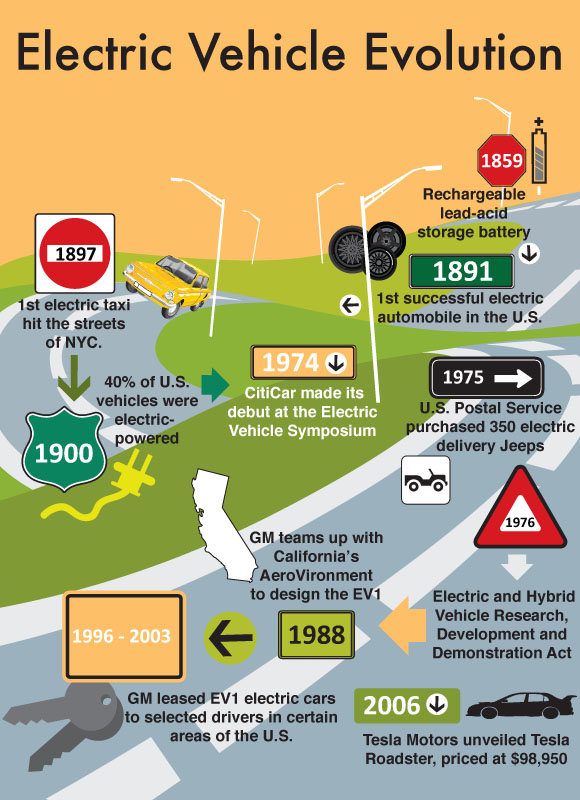
The Future of Energy Efficient Vehicles + (Infographic)

Flying cars were expected to be the future by 2000; despite erroneous expectations, cars have become radically advanced within recent years.  Cutting-edge technology has prompted the birth of the car of the future due to anxieties of energy efficiency and rising pollution.

By 2025, all new U.S. vehicles must be equipped with a 55mpg+ fuel range.  To contend with new fuel regulations, each year a car must be 5% more fuel-efficient.  The price at the pump is expected to increase 25% by 2025; presently, the average vehicle gulps an annual average of $1700.  Future hybrid & electric vehicles may cost $2400 more, but consumers will save $8200 in additional expenses.

Plug-in vehicles (PEV) or electric vehicles (EV) are gaining in popularity, but critics cite inflated prices, shortage of fueling stations, and limp technology advancements as probable disappointments. Despite the EV knockers, the Tesla Model S recently earned Car of the year for 2012 by Automobile Magazine and received Motor Trend’s Car of the Year honors in 2013.  Cadillac, BMW, Audi, and Honda are soon to follow in the EV trend in 2014.

Alternative fuels are the clean fuels of the future: liquid petroleum gas (LPG), ethanol, biodiesel, and natural gas.  LPG and natural gas are undoubtedly promising; these domestic fossil fuels yield less toxic pollutants and greenhouse gases.  Biodiesel, unlike its petroleum counterpart, originates from vegetable oils and animal fats. Corn and other domestic crops create ethanol.   The government promotes these unorthodox fuels with alluring tax incentives to qualifying consumers.

House Bill 2453 may leave an unpleasant taste in some consumer’s mouths after it is passed.  This tax, to be blunt, fines individuals to drive an electric vehicle.  This gas tax would be aimed at 2015 or later vehicles, with 55 miles/gallon or more.  A little background information: 60% of state projects are funded by taxes on gasoline.  Thus, states are collecting less tax money because of existing and future electric and hybrid vehicles.  Point blank, the fee would be 1.56 cents per mile.

These destined energy efficient vehicles could conceivably constitute 65% of the market in 2025.  Consumer demand, credits, and government incentives will determine the car dealership of the future.
energy-efficient-cars


Filed Under: Energy Efficiency Tagged With: biofuels, cars, electric car, energy, energy efficiency, energy efficiency projects, energy savings, ethanol, LPG, natural gas, propane, Tax Bill 2453, vehicles

May 14, 2013 by Kendal White

Manufacturing – Made in America (Infographic)

Generally, the mass population views manufacturing as beating hammers, arduous physical labor, and ancient assembly lines: employees don’t have to ponder their actions, due to their robotic movements.  Manufacturing has come light years since its birth in America.  Gone are the days of little pay, few benefits, and the distress of job outsourcing.

U.S. manufacturing, ‘made in the USA,’ is making its resurgence.  Factory employment has increased for the first time in more than a decade: 500,000 jobs created in three years.  The perception is manufacturing in the United States is slowly vanishing, and it may have appeared that outsourcing would be the demise of the American worker. Nevertheless, 30% of the country’s productivity progress is due to manufacturing.

Countless companies are reestablishing their manufacturing presence in America: Sleek Audio, Peerless Industries, The Coleman Company, NCR, Walmart, and Apple.   Companies are parting with their Chinese industrial divisions to move back to America; production in the U.S. will attain cost efficiencies, increase local control of the manufacturing process, and curtail lead times.  Mounting shipping and manufacturing costs have companies concerned about their future in China.

According to experts, the cost advantage associated with China is steadily declining.  American companies have won substantial allowances from Unions in the past 10 years; meanwhile, China’s middle class is demanding increased pay.  The United States has access to cheap energy, and its factories are profiting from the shale boom.  Planes and ships are transporting goods and materials thousands of miles outside of the U.S., and this translates to steep fuel prices.

Despite the sheer size of U.S. manufacturing, 10th largest economy in the world, China has the upper hand on future transportation.  China’s high-speed light rail system stretches from Beijing to Guangzhou to Shenzhen, and it will continue to challenge airmail rates.  The expansion of a high-speed rail system in America trails China by eons, yet China’s infrastructure lacks that of the United States’.  China’s sprawling cities possess millions of consumers, and this is its epicenter; its wealth is exceptionally concentrated.  The United States has a retail foundation stretching to secluded areas of the country due to the middle-class population base throughout the country.

An advanced breed of manufacturing is spreading in America: specialized manufacturing.  Specialized training and computer skills are in high demand because of progressive technologies and an increase in machine quantity.   Mastery of these machines is a necessity, and countless manufacturing positions are now demanding a 2-year technical degree, soon to be a 4-year degree.

Manufacturing in America is evolving and making its comeback.  The U.S. has solidified its place as the largest manufacturer of goods.

america-infographic

Filed Under: Manufacturing Tagged With: made in america, manufacturing

May 6, 2013 by Kendal White

Marketing in 2013 – Get Social

Social media has taken center stage in 2013.  Hundreds of millions of daily users log onto social media to check out the latest trends, idolize celebrities, chat with friends, and well, not do their work.  Long gone are the days of bland billboards and consumer disconnect.

Companies today interact with fans on a daily basis, and earn life-long loyalty through their interaction.  Social media engagement and Internet marketing is key to additional growth and revenue.

The more “traditional” marketing trends include Facebook and Twitter.  Twitter has more than 500 million uses, and Facebook has a staggering 1 billion.  Let’s take a moment to focus on Twitter: basically shortened Facebook updates, continuously.

Twitter’s continuous, stunted updates can be personalized into videos.  Vsnap records customized 60-second videos for individuals on Twitter; Vine app records 6-second video clips.  A branded Twitter account can become more human with interactions, as well as including the initials of the person tweeting at the end of each company tweet.  Each time I stumble across a boring tweet, I skip over it.  Companies that tweet humor grab attention, and gain brand awareness.  No one likes reading robotic tweets.

Take the time to interact with your followers: reply to compliments, questions, and those dreaded complaints.

infographic-marketing-blog

Instagram and Pinterest are visual social media outlets featuring pictures and infographics.  Instagram now permits followers to tag companies in photos; followers view and intermingle with images and other fans that provide images.  Creative hashtags (for those of you, this is #) and encouraging followers to submit personal photographs add to the personable persona of the company.  Get users engaged.

There are trends in 2013 for marketing: shades of green, monthly emails of Instagrammer’s photos, and a new style to email campaigns.

The color of the year is emerald green, and psychologically, this earthy color denotes renewal and harmony in a chaotic, unsettling world.  Use green in images, or contemplate swapping your current template out for a green one.

Instagram and Tumblr capitalize on photographs, and companies are now compiling their favorite user images into a monthly email.  Photograph products and team members to give followers a visual landscape of the company’s life.

Marketing blunders often include using only one media format to spread your message.  Try using two different formats minimum to reach a broad audience.  Social media users absorb information differently, and this can add multiple facets to your company.  Each social forum has its own vibe, and remain cautious of the types of information you blast.  Certain descriptions and headlines might snag attention on particular networks.  Select media outlets where you are marketing to your target audience.  Ultimately, customers desire to do business with companies and brands they identify.


UniTherm Insulation Systems currently engages its audience across multiple media outlets: Facebook, Twitter, Instagram, YouTube, Pinterest, and blogging.

Follow us:

Twitter: @UniTherm

Facebook: https://www.facebook.com/pages/Unitherm-Insulation-Systems

Instagram: unitherm

Pinterest: http://pinterest.com/unitherm/


Filed Under: From the Marketing Team Tagged With: Facebook, infographic, marketing, men vs. women, pinterest, social media, social media marketing 2013, twitter

April 29, 2013 by Kendal White

[Infographic] Reasons To Go Green

recycling-graphic

Top 10 Cleanest Countries

  1. Iceland
  2. Switzerland
  3. Costa Rica
  4. Sweden
  5. Norway
  6. Mauritius
  7. France
  8. Austria
  9. Cuba
  10. Columbia

 Types ofMost Recyclable Plastics 

  • PET or PETE (polyethylene terephthalate)
  • HDPE (high-density polyethylene)
  • PVC (polyvinyl chloride)
  • LDPE (low-density polyethylene)
  • PP (polypropylene)
  • PS (polystyrene)
  • Others


How to Recycle Plastic

  • Curbside Collection: some communities offer curbside collection of plastics for recycling
  • Bottle Banks: you can exchange plastic bottles for money in some states
  • Recycling Centers: take plastic items to be recycled


Recycling reduces the amount of plastic that ends up in landfills, decreases the amount of natural resources used to make plastic, and saves energy.


4 Reasons to Go Green

  • Endangered Animals: as many as 247 animals are on the critically endangered list as of 2008.
  • Deforestation: 8% drop in the amount of earth covered by rain forests.  Many experts suggest the rain forest will be entirely eliminated by 2050.
  • Global Warming: an increase in carbon dioxide that has led to global warming.
  • Growing Landfills: filled with trash that could take millions of years to decompose


Top 10 Polluting Countries 

  1. China
  2. United States
  3. Russia
  4. India 
  5. Japan
  6. Germany
  7. Canada 
  8. United Kingdom
  9. South Korea
  10. Iran


Filed Under: Energy Efficiency, Uncategorized Tagged With: 10 Cleanest Countries, 10 Most Polluting Countries, Deforestation, Endangered Animals, environment, green, plastics, Recycle

April 25, 2013 by Kendal White

Earth Day 2013 & 5 Native Wonders

Earth Day is an environmental movement celebrated each year on April 22.  Earth day was founded in 1970, when hippies and the Beatles ruled the land.  At the time, the environment was not a chief concern, and pollution was an accepted piece of economic growth.  Environmental efforts began to take popularity after a New York Times bestseller capitalized on our endangered environmental state.  Earth Day met the concerns in a society growing in environmental and public health anxieties.

The United States Environmental Protection Agency was birthed after the first Earth Day, as well as the Clean Air, Clean Water and Endangered Species Acts.  Throughout the years, Earth Day has tackled challenging environmental issues.  Despite these challenges, Earth Day 2013 was bursting with countries eager to do their part. ID-10048663

Here is our list of noteworthy, unfamiliar Earth Day countries:

  • Copenhagen, Denmark: Carbon emissions are a serious problem, and this city spelled ‘CO2’ via satellite navigation devices.
  • Tokyo, Japan: 100,000 people gathered in Yoyogi Park for a two-day music and art festival to commemorate Earth Day.
  • Pakistan: An initiative to plant 50,000 trees is being led to combat deforestation.
  • Philippines: The Solar Revolution Pavilion is a solar-powered building constructed with plastic bottles.  1,600 plastic vegetable crates were used to build this 200 square, 6-meter high structure. 
  • Indonesia: A parade to honor Earth Day was held; environmental issues include dwindling marine life and deforestation.
  • Taipei, Taiwan: Canon Marketing (Taiwan) Co. sponsored “Plant for the Planet: The Bill Tree Campaign” where participants plant trees.  The company promotes “kyosei” – working and living together for the good of the community.
  • Seoul, South Korea: Gangnam Style was revamped for an Earth Day flash mob.  Seoul also hosted an Earth Day exhibition and a walkathon.

Most of us take for granted the beautiful creation of Earth and we would like to give you five stunning places protected by Earth-lovers in the United States.

  1. San Francisco Bay, CA: The San Francisco Bay Association or Save the Bay, paved the way for the Conservation and Development Commission.  Windsurfers, birders, and boaters enjoy this clean bay today.
  2. Storm King Mountain, NY: The Scenic Hudson Preservation Conference was formed in the 1960s to combat a hydroelectric power facility.  The court ruling established conservation groups could challenge developments threatening the environment.
  3. Lady Bird Johnson Wildflower Center, TX: Lady Bird Johnson co-founded the Wildflower Center in 1982, which today runs a seed bank and aids in green community concepts.  Native Texas plants provide a beautiful backdrop to its landscape.
  4. Pelican Island, Florida: President Theodore Roosevelt declared Pelican Island a Federal Bird Reservation in 1903.  Pelican Island is a nesting site for egrets, herons, spoonbills, and an array of tropical birds.
  5. Dinosaur National Monument, Utah and Colorado: Thousands of dinosaur fossils were discovered here in 1915. In the 1950s the Bureau of Reclamation attempted to build a dam here, which would flood the Yampa and Green River canyons.  Congress blocked the dam in 1956, and today white-water rafters flock to this mecca.


UniTherm International is a manufacturer of green-friendly insulation blankets for all applications, specializing in the plastics and oil and gas industries. UniTherm strives for energy efficiency with all of our new and existing innovations.

Filed Under: From the Marketing Team Tagged With: conservation, Earth Day, Earth Day 2013, environment, green, UniTherm

April 23, 2013 by Kendal White

Renewable Energy And The Crusade Towards Innovation

Renewable energy is continually replenished and non-polluting: geothermal, sun, water, and wind.  The popularity of renewable energy is growing due to high oil prices, change, government legislation, and mounting government support paired with incentives. Greenhouse gases are detrimental to the Earth’s atmosphere; these gases allow sunlight to enter the atmosphere, thus trapping heat in the atmosphere.  These rising temperatures may trigger climate change.  Greenhouse gases in North America are primarily from energy consumption due to economic growth

Solar power technologies utilize the sun’s energy to provide electricity.  Solar power supplies less than 1% of U.S energy requirements; nevertheless, solar technologies are quickly advancing.  Solar technologies used for harnessing solar energy include photovoltaic cells, passive solar designs, and flat-plate collectors. The applications used to adapt solar power into electricity are costly, yet, the substantial potential of solar energy remains.

Hydropower is the most conventional renewable energy source, and uses flowing water to produce electricity. Major dam sites in the United States include the Tennessee Valley, the Colorado River, and the Northwest.  Hydropower is suitable for supplying large electricity requirements and is the least expensive renewable energy source.

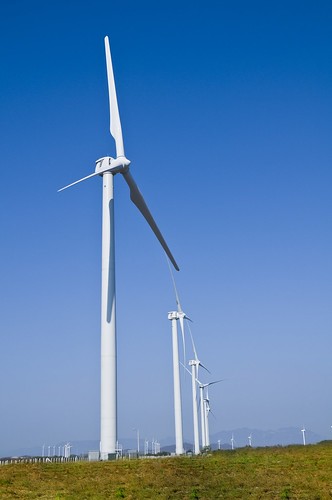
ID-10033605Wind energy applies wind turbines to generate electricity; this sector of renewable energy is the fastest growing.  Ideal placement for turbines is in an area of strong winds: Alaska, the Appalachians, and the western United States.

Geothermal energy utilizes natural sources of heat trapped beneath the Earth.  Underground hot water or steam is the conventional form of generating power.  Geothermal technologies embrace geothermal heat pumps, direct-use systems, and reservoirs.

Innovative technologies continuously attempt to improve the employment of renewable energy.

Livestock methane gas emission is a severe threat to the global climate.  In British Columbia, the Cowpower Program encourages residents to pay a slight percentage on their utility bill.  This premium will help pay for an anaerobic digester- bacteria is converted into organic material, creating energy.

Groundbreaking transportation could ease the reliance on fossil fuels for energy.  The invention of a speed vacuum train could be reality in the near future.  A speed-vac train is based upon the idea of removing the air from a sealed tub, and pressing a train through.  Conventional trains use a great deal of energy; the vacuum theory would be matched with magnetic levitation devices, allowing trains to reach 4,000 mph.

The latest in solar technology has spawned the idea of a device to trap light, which progresses the proficiency of organic solar shells by 175%.  This “black hole for light” could possibly allow for an economical, marketable solar shell.


Filed Under: Energy Efficiency Tagged With: efficiency, energy, environment, renewable

July 3, 2012 by Kendal White

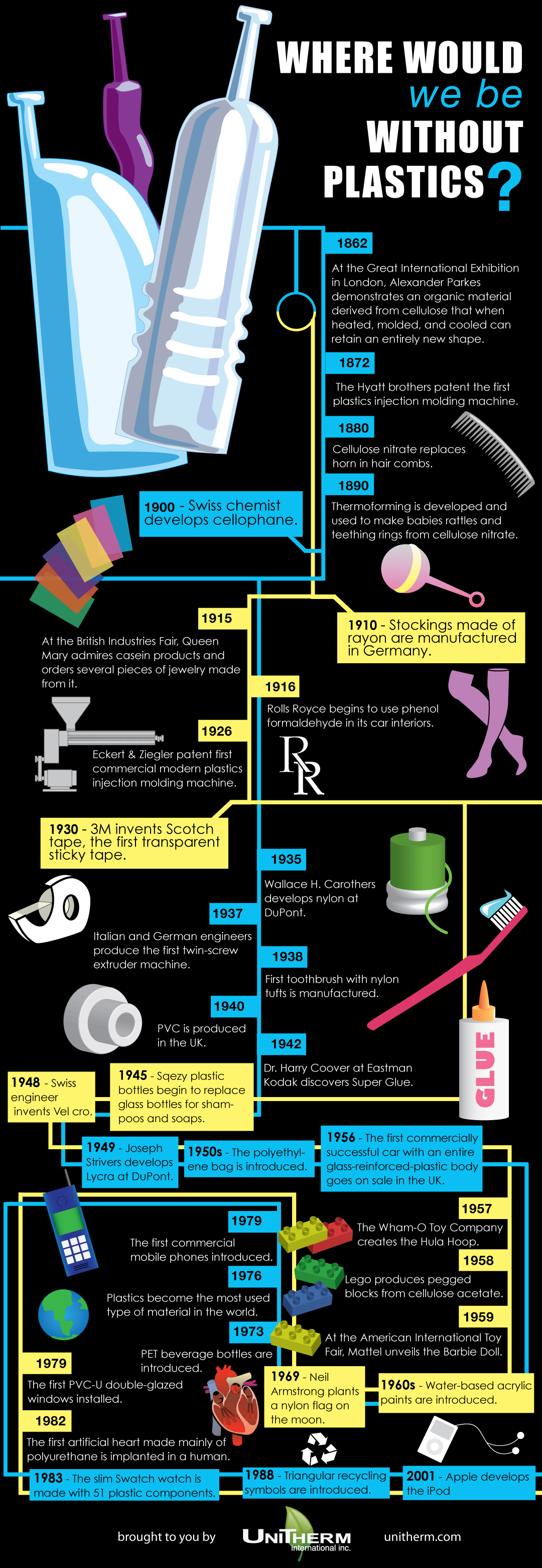
[Infographic] Where Would We Be Without Plastics?

There’s no denying that plastics are integrated into pretty much every part of our daily lives. Here at UniTherm, the plastics industry makes up a huge part of our business – so we thought it only fitting to do a little digging into the most significant advances in plastics.

Click to View Full Size

1862—At the Great International Exhibition in London, Alexander Parkes demonstrates an organic material derived from cellulose that when heated, molded, and cooled can retain an entirely new shape.

1868—Celluloid is used as a substitute for ivory in billiard balls.

1872—The Hyatt brothers patent the first plastics injection molding machine.

1880—Cellulose nitrate replaces horn in hair combs.

1890—Thermoforming is developed and used to make babies rattles and teething rings from cellulose nitrate.

1892—British chemists develop viscose silk (rayon).

1900—Swiss chemist develops cellophane.

1910—Stockings made of rayon are manufactured in Germany.

1915—At the British Industries Fair, Queen Mary admires casein products and orders several pieces of jewelry made from it.

1916—Rolls Royce begins to use phenol formaldehyde in its car interiors.

1926 – Eckert & Ziegler patent first commercial modern plastics injection molding machine.

1930—3M invents Scotch tape, the first transparent sticky tape.

1935—Wallace H. Carothers develops nylon at DuPont.

1937—Italian and German engineers produce the first twin-screw extruder machine.

1938 – First toothbrush with nylon tufts is manufactured.

1940—PVC is produced in the UK.

1942—Dr. Harry Coover at Eastman Kodak discovers Super Glue.

1945—Sqezy plastic bottles begin to replace glass bottles for shampoos and soaps.

1948—Swiss engineer invents Velcro.

1949—Tupperware made from low-density polyethylene launched in the US.

1949—Joseph Strivers develops Lycra at DuPont.

1950s—The polyethylene bag is introduced.

1956—The first commercially successful car with an entire glass-reinforced-plastic body goes on sale in the UK.

1957—The Wham-O Toy Company creates the Hula Hoop.

1958—Lego produces pegged blocks from cellulose acetate.

1959—At the American International Toy Fair, Mattel unveils the Barbie Doll.

1960s—Water-based acrylic paints are introduced.

1969—Neil Armstrong plants a nylon flag on the moon.

1973—PET (polyethylene terephthalate) beverage bottles are introduced.

1976—Plastics become the most used type of material in the world.

1979—The first commercial mobile phones introduced.

1979—The first PVC-U double-glazed windows installed.

1982—The first artificial heart made mainly of polyurethane is implanted in a human.

1983—The slim Swatch watch is made with 51 plastic components.

1988—Triangular recycling symbols are introduced.

1991—Dyson launches popular vacuum cleaner in Japan.

1994—A smart car is made with colored polycarbonate panels that are lightweight and flexible.

2001—Apple develops the iPod.

2009—Boeing nicknames a 747 “Boeing’s Plastic Dream” because 50% of the plane is made from plastic material.

Filed Under: Plastics Industry

July 2, 2012 by Kendal White

A Solution to Skilled Labor Shortage? Become a Company That Teaches

Manufacturing is no-doubt facing a crisis of shortage of skilled, experienced workers. Jobs are out there, ready to be filled, but qualified employees aren’t applying.

Manufacturers can look at the issue as a problem that falls on the shoulders of high schools, trade schools, universities and the educational system in the US in general — or they can take a proactive stance and become the teachers of tomorrow’s skilled workforce.

One manufacturing company just north of Dallas, Texas is doing just that. UniTherm International is a manufacturer of finished industrial and commercial insulation products. During a time when most small businesses have pulled back, aimed to simply stay afloat, or worse have been forced to close their doors, UniTherm sees the current economic conditions as an opportunity to grow and leave its competitors behind.

One challenge this manufacturing company faces as demand continues to increase is finding experienced and skilled industrial sewing machinists. Like any other challenge UniTherm has faced during this period of aggressive growth, they have met it head on with a unique solution that benefits an entire community.

The month of July will kick off a series of free, hands-on industrial sewing classes. Anyone is welcome to join, and spots will be filled on a first come first serve basis. Throughout these free classes students will learn the basics of operating an industrial sewing machine and reading work orders and product drawings.

Some students will finish the classes with a job offer, but all will have the hands-on experience and skills many manufacturers are looking for, but struggling to find, in potential employees.

Interested in attending or learning more about the sessions? Contact UniTherm International at info@unitherm.com or 800.657.9542.

Filed Under: Manufacturing

June 6, 2012 by Kendal White

Budgeting For Energy Efficiency Projects

Budgeting for energy efficiency projectsCompanies always look to make the best decisions when selecting capital projects to work into the budget; simple metrics like Return on Investment and Internal Rate of Return tend to dictate how the budget for these projects is written each year. In an effort to increase the bottom line, investments are often times funneled toward projects and purchases that directly affect sales rather than decreasing operating costs, but sales growth is never guaranteed.
In other cases, capital projects are indefinitely suspended, forcing companies to make due with what they have until either more funding becomes available or sales increase. [Read more…]

Filed Under: Energy Efficiency Tagged With: capital projects, costing, costs, energy conservation, energy consumption, energy costs, energy efficiency, energy efficiency projects, energy efficiency system, energy management, energy policy of the united states, energy projects, energy rebate program, energy star, indefinitely, projects, rebate, sales promotion, save energy

June 1, 2012 by Kendal White

Manufacturing Matters: June 1, 2012 Weekly Wrap Up

Mainbiz, a business news source, offered tips for finding ways to save energy at virtually any business. Simple things like space heaters and soda machines add up to hefty energy costs. Where can you save energy costs in your business?

Image via Flickr - Walmart Corporate

The Sacramento Bee reports that California may be missing out on ‘green’ manufacturing jobs. While California is a leader in encouraging renewable energy, almost all green technology products are manufactured outside of the state. As a state facing double-digit unemployment, luring manufacturing back to California could help fuel the state’s economy and offer jobs to the thousands of unemployed workers.

According to The Daily Camera, Boulder is considering commercial energy-efficiency requirements as voluntary incentives have not produced the energy reduction the city hoped to achieve. The program would start with expanding current inventive programs, followed by a mandatory energy rating and reporting. Read more 

Have a Reshoring Story to Tell? IMTS and ReshoreNow.org are offering the chance to tell your reshoring story and will showcase selected stories as part of the Manufacturing Technology Drives Reshoring program. (thanks @ajsweatt for sharing this link)

Market Watch reports that the Obama administration launches $26 million multi-agency competition to strengthen advanced manufacturing clusters across the nation. “The Jobs Accelerator Challenge is one way the federal government is helping to support the manufacturing industry, a vital source of middle-class jobs,” said Secretary of Labor Hilda L. Solis. “The innovative products developed as a result of this federal grant program will help our economy maintain its global competitive advantage, while also creating jobs at home.” Read more (thanks @mfrsnews for sharing this link)

Filed Under: Energy Efficiency, Manufacturing, Plastics Industry

« Previous Page
Next Page »

Quick Links

MSDS
Product Brochures
Energy Study Library
Product Videos

Follow UniTherm

Facebook
Twitter
Blog
YouTube
Instagram
Pinterest

UniTherm Insulation Systems

711 Jones St.
Lewisville, TX 75057
Toll Free: 800.657.9542
Phone: 972.436.1401
Fax: 972.436.0112
info@unitherm.com

Copyright © 2026 · Executive Pro Theme on Genesis Framework · WordPress · Log in

  • Español