Water freezes at approximately 32°F (0°C) under ordinary conditions but that doesn’t mean every pipe on site freezes when the outdoor temperature drops to 31°F. Effective industrial pipe freeze protection depends on understanding what actually happens between “cold outside” and “frozen solid,” and that gap is where engineering judgment matters most.
There’s another critical variable at play: time.
A pipe and the fluid inside it hold thermal energy. When ambient temperature falls below fluid temperature, heat transfers from the warmer system toward the colder surroundings. This means the fluid’s temperature drops as that energy is lost. Freezing isn’t a light switch — it’s the end point of a heat-loss process that unfolds over minutes, hours, or days depending on the system.
The Variables That Determine Freeze Risk
Estimating how long stagnant water in an insulated pipe takes to cool to freezing accounts for several variables, including:
- Initial water temperature
- Ambient temperature
- Pipe inside diameter
- Water density
- Specific heat
- Thermal resistance of the pipe and insulation
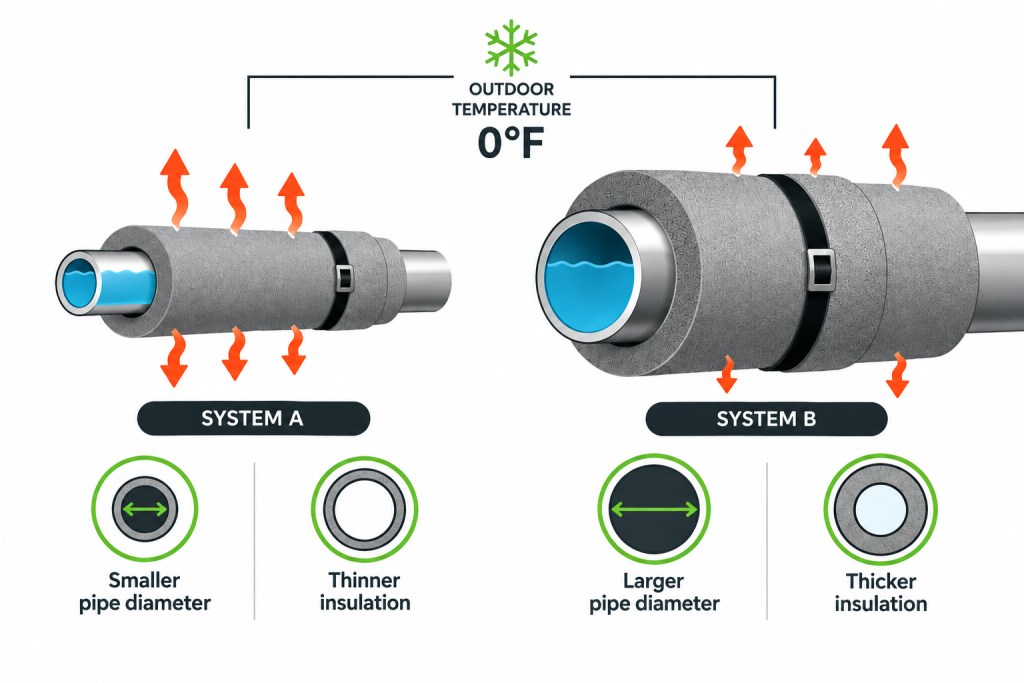
With so many factors are involved, two piping systems exposed to the exact same outdoor temperature might behave very differently. Changing pipe diameter or insulation thickness, for instance, changes the thermal characteristics of the whole system. A larger volume of water retains more heat relative to its surface area, while thicker insulation slows how quickly heat escapes.
Fluid movement matters just as much. When sufficient flow is maintained, insulation can do its job retaining heat. This is because continuous water flow brings new thermal energy into the exposed section of pipe. Stagnant or insufficiently flowing water doesn’t have that same continuous heat source. Meaning dead legs, idle lines, and low-flow branches are consistently where freeze failures start.
Insulation Changes the Rate — Not the Freezing Point
It’s worth being precise about what insulation actually does. Adding insulation doesn’t change water’s freezing temperature. Instead, it increases resistance to heat transfer, which slows the rate at which the fluid loses heat to its surroundings.
Given enough time under sufficiently cold conditions, stagnant water can still freeze insulation alone buys time, it doesn’t guarantee protection indefinitely. That’s why engineers shouldn’t evaluate freeze risk based only on the question:
“Will the temperature fall below 32°F?”
A better question is:
“How much heat will this system lose under our design conditions, and how long can the fluid remain above its critical temperature?”
That perspective shift from a single threshold to a heat-loss and time calculation is the foundation of effective freeze protection.
Designing for Freeze Risk, Not Just Freeze Temperature
Freeze protection engineered around heat-loss variables holds up far better under real winter conditions than protection based on a single degree threshold. Whether that means sizing insulation correctly, specifying heat tracing for stagnant or low-flow lines, or identifying the dead legs most likely to fail first, the right approach starts with the math, not the thermometer.
This is week 2 of a 10 week series discussing the methods and science of frost protection systems. To learn more or to follow this series click this link: Subscribe to Updates
To find out more information on the frost protection offerings that Unitherm International can provide, go to shop.unitherm.com to view our full listing of products or email quote@unitherm.com to speak to a representative about custom insulation solutions.