Unitherm Insulation Systems

  • Home
  • Shop
  • Insulation Solutions
    • Plastics Equipment Insulation
    • Pipe and Valve Insulation
    • Passive Fire Protection
    • Freeze Protection and Material Handling
    • Exhaust Insulation
    • Marine Exhaust Insulation
    • Rigid Board Insulation
    • OEM
  • Applications
    • Aerospace
    • Data Centers
    • Defense
    • Exhaust Systems
    • Gas Compressors
    • Locomotive
    • Marine
    • Oil and Gas
    • On Highway
    • Power Generation
    • Reciprocating Engines
    • Turbines
  • Services and Capabilities
    • Custom Insulation Blankets, Jackets, and Covers
    • 3D AutoCAD
    • High Temperature Raw Goods
    • Custom Embroidery
    • WaterJet/CNC Machining
    • Private Labeling
  • Reseller Program
    • Reseller Locator
  • Blog
  • About
    • Contact
    • News
    • Customer Service
    • Order Now
  • Media
    • Documents
    • MSDS Sheets
    • Product Literature
    • Product Gallery
    • Video
    • Energy Study Library
    • New Customer Form
  • NPE 2027

October 13, 2026 by UniAdmin

The 7 Variables That Determine Pipe Freeze Risk

The Variables That Determine Pipe Freeze Risk

There isn’t one number that tells an engineer whether an industrial pipe needs freeze protection. Freeze risk is the result of several interacting design conditions, not a single ambient-temperature threshold — which is why a proper freeze protection design starts well before anyone selects equipment.

Heat-tracing manufacturers begin their freeze-protection design processes by establishing those conditions first. Here are the variables that matter most.

1. Minimum Ambient Temperature

The greater the difference between the desired pipe temperature and the surrounding temperature, the greater the potential heat loss. The appropriate design ambient should reflect the actual location and application, not a generic regional low.

Outdoor air temperature isn’t always the relevant number. Piping in unheated buildings or unconditioned spaces can be exposed to freezing conditions at different minimum ambient temperatures than what’s happening outside.

2. Desired Maintenance Temperature

Freeze protection doesn’t necessarily mean designing exactly to 32°F. Different fluids and processes can require different maintenance temperatures. Highly viscous fluids may need to be maintained above their freezing temperature simply to retain the viscosity necessary for flow.

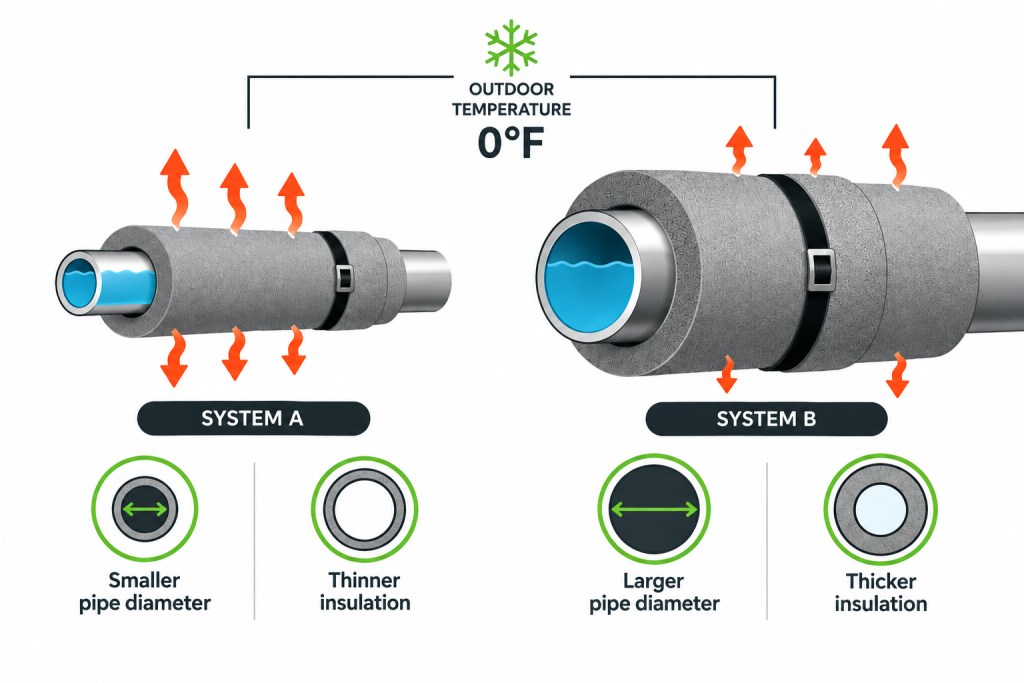
3. Pipe Diameter

Pipe dimensions influence both the amount of fluid contained within the pipe and the thermal characteristics of the system. Freeze-time calculation and commercial heat-tracing design procedures account for pipe size, since a larger volume of fluid relative to surface area behaves differently than a smaller one.

4. Pipe Material

Thermon and nVent both include pipe material among the information required during heat-tracing design. The correct design should be based on the actual piping construction rather than assuming all pipes behave identically — different materials conduct heat at different rates.

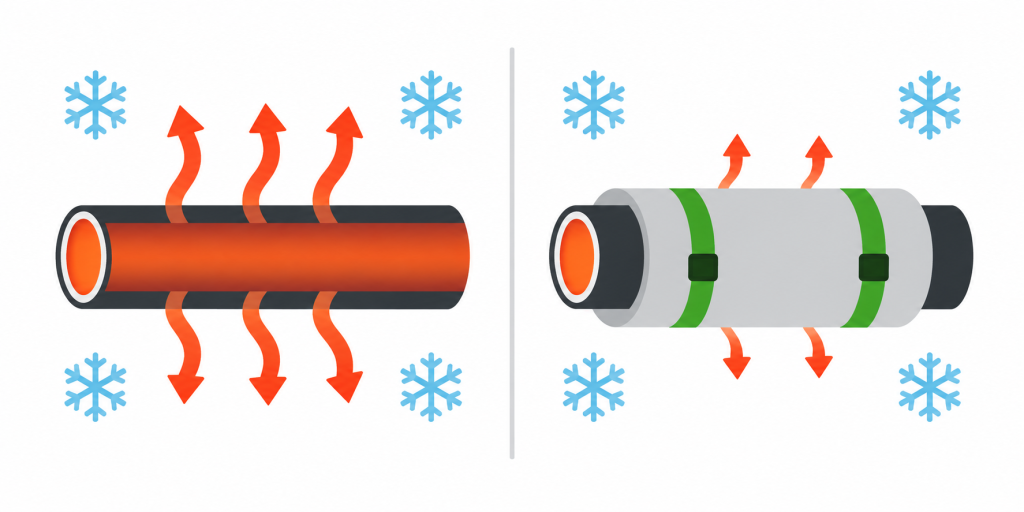
5. Insulation

Insulation type and thickness directly affect heat loss. ASHRAE’s pipe-tracing heat-load calculation includes the dimensions and thermal properties of the insulation surrounding the system, since insulation slows heat loss rather than eliminating it.

6. Flow Conditions

A flowing system can behave very differently from a stagnant one. ASHRAE specifically notes that sufficient flow can prevent freezing, because the available heat content of the moving water offsets the system’s heat loss. Stagnant or low-flow sections don’t have that same continuous heat source, which is why they carry disproportionately higher freeze risk.

7. Equipment and Supports

Straight pipe isn’t the entire system. UniTherm’s design process requires designers to account for valves, pumps, other equipment, and pipe supports when determining heat-trace circuit lengths.

Evaluate Freeze Risk as a System, Not a Single Number

The lesson across all seven variables is the same: freeze risk should be evaluated as a thermal system, not from ambient temperature alone. Minimum ambient, maintenance temperature, pipe size and material, insulation, flow, and equipment all interact to determine how — and whether — a given line freezes.

UniTherm designs freeze protection around these actual operating conditions rather than a single temperature threshold. If you’re evaluating freeze risk for piping, tanks, or instrumentation on your site, contact our team to walk through the variables specific to your system.


This is week 3 of a 10 week series discussing the methods and science of frost protection systems. To learn more or to follow this series click this link: Subscribe to Updates

To find out more information on the frost protection offerings that Unitherm International can provide, go to shop.unitherm.com to view our full listing of products or email quote@unitherm.com to speak to a representative about custom insulation solutions.
Filed Under: Freeze Protection, Uncategorized Tagged With: energy conservation, manufacturing, thermal insulation

October 6, 2026 by UniAdmin

Why Industrial Piping Freezes: It’s More Than Just 32°F

Water freezes at approximately 32°F (0°C) under ordinary conditions but that doesn’t mean every pipe on site freezes when the outdoor temperature drops to 31°F. Effective industrial pipe freeze protection depends on understanding what actually happens between “cold outside” and “frozen solid,” and that gap is where engineering judgment matters most.

There’s another critical variable at play: time.

A pipe and the fluid inside it hold thermal energy. When ambient temperature falls below fluid temperature, heat transfers from the warmer system toward the colder surroundings. This means the fluid’s temperature drops as that energy is lost. Freezing isn’t a light switch — it’s the end point of a heat-loss process that unfolds over minutes, hours, or days depending on the system.

The Variables That Determine Freeze Risk

Estimating how long stagnant water in an insulated pipe takes to cool to freezing accounts for several variables, including:

  • Initial water temperature
  • Ambient temperature
  • Pipe inside diameter
  • Water density
  • Specific heat
  • Thermal resistance of the pipe and insulation

With so many factors are involved, two piping systems exposed to the exact same outdoor temperature might behave very differently. Changing pipe diameter or insulation thickness, for instance, changes the thermal characteristics of the whole system. A larger volume of water retains more heat relative to its surface area, while thicker insulation slows how quickly heat escapes.

Fluid movement matters just as much. When sufficient flow is maintained, insulation can do its job retaining heat. This is because continuous water flow brings new thermal energy into the exposed section of pipe. Stagnant or insufficiently flowing water doesn’t have that same continuous heat source. Meaning dead legs, idle lines, and low-flow branches are consistently where freeze failures start.

Insulation Changes the Rate — Not the Freezing Point

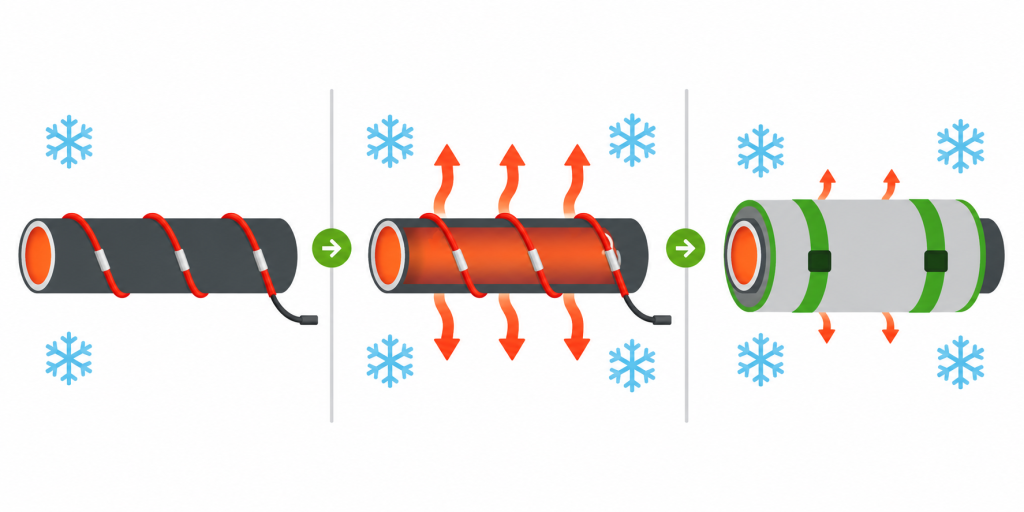
It’s worth being precise about what insulation actually does. Adding insulation doesn’t change water’s freezing temperature. Instead, it increases resistance to heat transfer, which slows the rate at which the fluid loses heat to its surroundings.

Given enough time under sufficiently cold conditions, stagnant water can still freeze insulation alone buys time, it doesn’t guarantee protection indefinitely. That’s why engineers shouldn’t evaluate freeze risk based only on the question:

“Will the temperature fall below 32°F?”

A better question is:

“How much heat will this system lose under our design conditions, and how long can the fluid remain above its critical temperature?”

That perspective shift from a single threshold to a heat-loss and time calculation is the foundation of effective freeze protection.

Designing for Freeze Risk, Not Just Freeze Temperature

Freeze protection engineered around heat-loss variables holds up far better under real winter conditions than protection based on a single degree threshold. Whether that means sizing insulation correctly, specifying heat tracing for stagnant or low-flow lines, or identifying the dead legs most likely to fail first, the right approach starts with the math, not the thermometer.


This is week 2 of a 10 week series discussing the methods and science of frost protection systems. To learn more or to follow this series click this link: Subscribe to Updates

To find out more information on the frost protection offerings that Unitherm International can provide, go to shop.unitherm.com to view our full listing of products or email quote@unitherm.com to speak to a representative about custom insulation solutions.
Filed Under: Freeze Protection, Manufacturing, Safety, Uncategorized Tagged With: freeze protection, FreezePro® Frost Protection Systems, manufacturing

September 29, 2026 by UniAdmin

Freeze Protection: A Guide for Engineers and Maintenance Personnel

Freezing temperatures can create significant problems for industrial piping, valves, equipment, and the fluids moving through them. But effective freeze protection involves more than simply wrapping a pipe in insulation.

A properly designed system starts by understanding how heat moves from the fluid and piping system into the surrounding environment.

What Does Insulation Actually Do?

Thermal insulation limits heat transfer between a surface and its surroundings. In freeze-protection applications, this means slowing the rate at which heat leaves a warmer pipe, vessel, or piece of equipment and moves into colder ambient air.

While insulation does not generate heat, nor does it completely stop heat transfer. Insulation can extend the amount of time required for water to freeze. Prolonged exposure to cold temperatures can eventually freeze stagnant water even when the pipe is insulated, leading to cracks and bursts.

When Heat Is Required?

When natural fluid flow and/or insulation cannot provide adequate protection from freezing temperatures, it’s important to consider thermal heating methods.

One of the most common heating methods, and the method found in FreezePro insulation systems is heat tracing cable.

Traditionally Heat trace cable is wrapped around the pipe and secured with insulated blankets such as ceramic fiber blankets, however, FreezePro products combine the two for easy one step install.

The essential concept is that the two products are serving complementary functions;
the heat trace supplies the heat and the insulation retains the heat.

Regardless of how you choose to pair your heat trace and insulation combo, the essential concept is that the two products are serving complementary functions; the heat trace supplies the heat and the insulation retains the heat.

What Engineers Should Consider

Freeze protection isn’t as simple as the outdoor temperatures. There are many factors that can lead to frozen pipes and in turn, pipe damage. Here’s a list of a few thing any engineer should think about when creating a frost protection plan.

  • Pipe diameter
  • Pipe length
  • Pipe material
  • Minimum ambient temperature
  • Available electrical supply
  • Desired maintenance temperature
  • Startup temperature
  • Insulation type
  • Insulation thickness

Freeze Protection Is a System

The most useful way to approach freeze protection is therefore to look at the entire thermal system rather than one component. Engineers should consider the fluid, piping, equipment, insulation, environmental conditions, heat source when required, controls, and weather protection. When you understand the heat loss of a system you can then provide an adequate means of controlling it.

This is week 1 of a 10 week series discussing the methods and science of frost protection systems. To learn more or to follow this series click this link: Link

To find out more information on the frost protection offerings that Unitherm International can provide, go to shop.unitherm.com to view our full listing of products or email quote@unitherm.com to speak to a representative about custom insulation solutions.

Filed Under: Freeze Protection, Manufacturing, Uncategorized Tagged With: energy conservation, manufacturing

September 22, 2026 by UniAdmin

Building a 90-Day Process Heating Improvement Plan for Your Facility

Over the past twelve weeks, we’ve covered the fundamentals of process heating efficiency — from how energy is lost to how to make the financial case for improvements. This final post in the series offers a practical framework for putting those concepts into action over a 90-day window.

Unitherm recommends starting with a systems approach, identifying the components with the highest efficiency impact, analyzing those components in detail, and then implementing improvements in a sequence that accounts for how changes in one component affect others.

Days 1–30: Audit and Inventory

The first month is about understanding what you have. This means conducting a surface temperature survey of your process heating equipment using an infrared thermometer or thermal camera — noting which surfaces are running significantly above ambient. It also means documenting the insulation condition on pipes, valves, ductwork, and equipment: what’s insulated, what’s not, and what’s damaged or missing.

For fuel-fired systems, this is also the time to check exhaust gas oxygen content and verify that burners are operating at or near the target excess air level. A combustion analyzer can do this quickly.

The DOE’s Process Heating Assessment Tool (PHAST) is available as a free download through the Advanced Manufacturing Office and can help structure this assessment phase.

Days 31–60: Prioritize and Plan

With the audit data in hand, prioritize opportunities by two criteria: magnitude of the energy loss and ease of implementation. Insulation improvements on large, hot, uninsulated surfaces typically score well on both — significant energy impact, relatively straightforward to address.

For combustion adjustments, consult your equipment documentation and work with a qualified technician to verify setpoints before making changes.

For more complex improvements — waste heat recovery systems, burner upgrades, process controls — develop a project scope and get engineering input before committing resources.

Days 61–90: Implement and Measure

The third month is for acting on the highest-priority items and measuring results. For insulation improvements, that means ordering and installing covers, jackets, or blankets on the priority surfaces. For combustion adjustments, it means making the calibration changes and monitoring results.

Measure performance against baseline: energy use per unit of production before and after. Even simple tracking of monthly fuel or electricity consumption by system can reveal the impact of improvements.

UniTherm offers removable and reusable insulation solutions across the full range of surfaces identified in a process heating audit: plastics equipment (UniVest®), pipes and valves (IsoCovers), exhaust systems, and fire protection (FirePro). For a facility-wide insulation assessment, contact the UniTherm team at info@unitherm.com or 800.657.9542. We’re based in Lewisville, TX and serve facilities nationwide.

Keep Going After 90 Days

Each round of improvements creates a new baseline from which the next round of opportunities can be identified. Facilities that build efficiency review into their regular maintenance and operational planning consistently outperform those that treat it as a one-time project.

The resources referenced throughout this series — including the full DOE Sourcebook, tip sheets, and the PHAST tool — are available free through the Advanced Manufacturing Office at energy.gov/eere/amo. They’re worth keeping on hand.

For our standard removable insulation solutions, visit shop.unitherm.com.

To request a quote for a custom insulation solutions click here.

Source: U.S. DOE, Improving Process Heating System Performance: A Sourcebook for Industry (Third Edition), 2015.

This concludes our 13-week content series. For questions, insulation samples, or to discuss your facility’s needs, contact UniTherm at unitherm.com or 800.657.9542.

Filed Under: Energy Efficiency, Manufacturing, Uncategorized Tagged With: efficiency, energy, energy conservation, energy efficiency, energy management, environment, lean manufacturing, manufacturing, plastics, thermal insulation

September 8, 2026 by UniAdmin

Sustainability in Process Heating: What Manufacturers Need to Know in 2026

Sustainability has moved from a background consideration to a front-of-mind issue for manufacturers. Customers are asking about it. Regulators are requiring reporting on it. And the economic case for sustainable manufacturing practices is increasingly difficult to separate from the case for operational efficiency.

Sustainable manufacturing is the ability to continuously utilize resources to manufacture products and maintain the environment and our lifestyles indefinitely. Sustainability requires that our resources remain at their current levels or improve for future generations.

Why Process Heating Is Central to the Sustainability Conversation

Process heating accounts for roughly 61% of manufacturing on-site energy use in the U.S. It is also a significant source of combustion emissions — emissions are directly proportional to fuel consumption. Reducing energy use in process heating reduces the carbon footprint of manufacturing at scale.

The key sustainability metrics for manufacturing operations: volume of solid waste per unit of finished goods, energy input per unit of production, tons of carbon emissions per unit shipped, and gallons of waste water per unit shipped. Improving process heating efficiency directly improves the energy intensity and carbon emissions metrics.

The Role of Insulation in a Sustainability Program

Insulation is one of the most straightforward sustainability investments available to a manufacturing facility. Reducing surface heat loss reduces the energy input required per unit of production — directly improving energy intensity. And because emissions are tied to fuel use, less fuel means fewer emissions.

Insulation improvements that reduce energy use and emissions are a visible, documentable part of a sustainability program.

UniTherm’s removable and reusable insulation products support sustainability on two levels: they reduce energy consumption during use (lower heat loss = less fuel burned), and they’re reusable rather than disposable — which supports waste reduction goals. UniTherm’s products are engineered to last, reinstall cleanly, and be removed without generating waste. Visit unitherm.com to learn more.

For our standard removable insulation solutions, visit shop.unitherm.com.

To request a quote for a custom insulation solutions click here.

Source: U.S. DOE, Improving Process Heating System Performance: A Sourcebook for Industry (Third Edition), 2015.

Filed Under: Energy Efficiency, Manufacturing, Uncategorized Tagged With: efficiency, energy, energy conservation, energy efficiency, energy management, environment, lean manufacturing, manufacturing, plastics, thermal insulation

August 25, 2026 by UniAdmin

Preheating Combustion Air: A Proven Method for Reducing Fuel Use in Industrial Furnaces

For fuel-fired process heating systems operating at high temperatures, preheating combustion air is one of the most well-established and effective methods for reducing fuel consumption. The principle is simple: if the air entering the burner is already warm, less fuel is needed to achieve the required combustion temperature.

Combustion air preheating is the most commonly used method of waste heat recycling for high-temperature fuel-fired systems. It works by capturing heat from the hot exhaust gases and transferring it to the incoming combustion air — typically using a recuperator, regenerator, or heat pipe.

How the Savings Add Up

Combustion air represents a significant portion of the mass flowing through a furnace. Every degree of preheating reduces the fuel burden on the burner.

Depending on the system, exhaust gas temperature, and method of heat recycling, the sourcebook reports that it is possible to reduce energy intensity by 5% to 25% for heating systems. For systems with high exhaust temperatures, the upper range of that estimate is realistic.

When Preheating Is Most Applicable

For most fuel-based systems with relatively high exhaust temperatures — typically above 1,000°F — combustion air preheating is the natural first candidate for waste heat recycling. For processes using high volumes of air, such as drying ovens, preheating of makeup air or dilution air should also be considered.

For systems with lower exhaust temperatures or constrained configurations, other forms of waste heat management — including insulation improvements and load preheating — may offer better economics.

The Relationship to Insulation

It’s worth noting that combustion air preheating and insulation improvements are complementary, not competing. The sourcebook is explicit: tuning burners and improving insulation reduce the baseline energy consumption, which in turn reduces the magnitude of exhaust losses. Pursuing both together — reducing waste heat generation through insulation and recovering remaining exhaust heat through preheating — produces larger combined savings than either approach alone.

For exhaust systems and related components where heat management matters, UniTherm provides high-temperature insulation solutions for exhaust lines and associated hardware. Keeping exhaust temperature predictable and reducing incidental losses from exhaust piping supports the effectiveness of downstream heat recovery systems. Visit unitherm.com to learn more.

For our standard removable insulation solutions, visit shop.unitherm.com.

To request a quote for a custom insulation solutions click here.

Source: U.S. DOE, Improving Process Heating System Performance: A Sourcebook for Industry (Third Edition), 2015.

Filed Under: Energy Efficiency, Manufacturing, Uncategorized Tagged With: efficiency, energy, energy conservation, energy efficiency, energy management, environment, lean manufacturing, manufacturing, plastics, thermal insulation

August 4, 2026 by UniAdmin

Removable Pipe and Valve Insulation: Solving the Access Problem in Industrial Facilities

Every industrial facility has piping systems that carry hot fluids, steam, or gases. And most of those systems have lengths of pipe, valves, and flanges that are uninsulated — not because facility managers don’t understand the energy loss, but because traditional insulation creates a maintenance problem.

When you need to access a valve for inspection or repair, you have to remove whatever insulation is covering it. With hard insulation, that means cutting and disposing of material. The replacement costs time and money. Do it a few times and the insulation often just stays off.

Pipe and Component Insulation

The Department of Energy’s identifies poor insulation on piping and ductwork as a recognized source of energy loss. Surfaces such as piping and ductwork that have poor or no insulation are sources of energy loss that are “often overlooked” in process heating assessments.

This is common precisely because the losses are diffuse and continuous rather than dramatic. A valve loses heat quietly, hour after hour, day after day. The impact is real but easy to ignore.

What Removable Insulation Covers Actually Do

Removable insulation covers for valves, flanges, and pipe components are engineered to be installed and removed without tools or specialized labor. They’re typically made from high-temperature-rated materials, stitched or sealed to fit specific component configurations, and secured with straps, lacing, or fasteners that allow for quick removal.

The key advantage over traditional insulation is that the covers are designed from the start to be removed and reinstalled. The insulation material doesn’t get damaged in the process, so the cover remains effective after repeated use.

UniTherm’s IsoCovers are removable insulation covers for valves and flanges. They’re available in standard sizes through the UniTherm shop and can be custom-manufactured for non-standard component configurations. Visit unitherm.com/pipe-and-components for the full range, or contact UniTherm to discuss a custom solution for your system.

Industries That Use Them

Removable pipe and valve insulation is used in oil and gas, power generation, chemical processing, food processing, marine applications, and anywhere else that high-temperature piping systems require regular maintenance access. The ROI case is generally straightforward: the energy cost of an uninsulated valve running continuously at operating temperature is often large enough to recover the cost of the cover within a single heating season.

For facilities in cold climates, there’s an additional benefit: reducing surface heat loss can help maintain consistent process temperatures in areas where ambient conditions vary seasonally.

For our standard removable insulation solutions, visit shop.unitherm.com.

To request a quote for a custom insulation solutions click here.

Filed Under: Energy Efficiency, Manufacturing, Uncategorized Tagged With: efficiency, energy, energy conservation, energy efficiency, energy management, environment, manufacturing, plastics, thermal insulation

July 28, 2026 by UniAdmin

Insulating Plastics Processing Equipment: How to Really Cut Your Facility’s Costs.

Plastics processing equipment, injection molding machines, extruders, blow molding equipment — operate at sustained high temperatures. The heating zones along a barrel or nozzle are running continuously, and a significant portion of that heat radiates outward into the surrounding work area rather than staying in the process where it belongs.

This is a straightforward heat containment problem of the kind identified in the DOE’s process heating sourcebook, and it has a straightforward solution: insulating plastic processing equipment keeps the heat in the barrel and out of the shop floor.

What’s Actually Happening Without Insulation

An uninsulated barrel on a plastics processing machine loses heat through radiation and convection from its surface. The control system compensates by running the heaters longer or more frequently to maintain the set temperature. More heater activity means more energy consumed, more wear on heating elements, and a warmer ambient environment around the machine.

The DOE sourcebook notes that improving insulation on process heating equipment reduces the amount of energy needed to perform a given heating task, reduces thermal stress on system components, and can improve consistency and product quality. All three of those benefits apply to plastics processing equipment.

The Case for Removable Insulation on Barrels and Nozzles

Permanent insulation on a plastics processing barrel is impractical. Operators need access to heating zones for inspection, thermocouple replacement, and maintenance. Fixed insulation that has to be cut away and replaced every time someone needs to check a heater band is not a workable solution.

Removable insulation jackets address this directly. They’re designed to fit specific equipment configurations, attach securely during production, and come off quickly when access is needed. The insulation itself is protected from damage during removal, so it can be reinstalled and reused.

UniTherm’s UniVest® insulation jackets are designed specifically for plastics processing equipment — barrels, nozzles, dies, and related components. They’re engineered for the temperature ranges and access requirements typical of injection molding, extrusion, and blow molding operations. Available through the UniTherm shop at shop.unitherm.com.

What to Expect in Terms of Results

While results vary by equipment type, temperature setpoint, and ambient conditions, published energy studies have documented meaningful reductions in heater band energy consumption when insulation jackets are added to plastics processing equipment. In addition to direct energy savings, facilities often report reduced ambient heat in work areas around the machines — a worker comfort and safety benefit that the DOE sourcebook also identifies as a legitimate benefit of insulation improvements.

UniTherm maintains an Energy Study Library on its website with documented results from insulation applications. Visit unitherm.com/media/energy-study-library for case data.

For our standard removable insulation solutions, visit shop.unitherm.com.

To request a quote for a custom insulation solutions click here.

Source: U.S. DOE, Improving Process Heating System Performance: A Sourcebook for Industry (Third Edition), 2015.

Filed Under: Energy Efficiency, Manufacturing, Plastics Industry, Uncategorized Tagged With: efficiency, energy, energy conservation, energy efficiency, energy management, environment, lean manufacturing, manufacturing, plastics, thermal insulation

July 21, 2026 by UniAdmin

Heat Containment: Why Insulation Is Usually the First Step in Any Efficiency Program

The Department of Energy’s process heating sourcebook divides efficiency improvements into five categories. Of those five, heat containment stands out as the one most facilities can act on quickly, without major capital investment and without interrupting production.

Heat containment means reducing energy losses to the surrounding environment. Every surface that runs hotter than ambient temperature is a source of those losses. The hotter the surface and the larger the area, the more energy is leaving the system and adding to your fuel bill.

What the DOE Sourcebook Says About Insulation

The sourcebook is direct about what poor insulation costs: “Poor insulation might reduce a process heating system’s efficiency, thereby increasing the amount of energy needed to perform a given process heating task. In addition to an increased cost for energy, the system is exposed to higher stress, which can accelerate wear and subsequently lead to more frequent breakdowns. Other side effects can be reduced product quality and increased maintenance.”

That last point is important. Insulation isn’t just about energy savings. When equipment runs hotter than it needs to because heat isn’t being retained properly, the surrounding components experience greater thermal stress. Over time, that means shorter service life and more downtime.

Where Insulation Applies

Insulation opportunities in a process heating system typically include: furnace and oven walls, doors, and ceilings; pipes, valves, and flanges carrying hot fluids, gases, or steam; ductwork connecting heating equipment to downstream processes; heating barrels, nozzles, and dies on plastics processing equipment; and exhaust components that carry high-temperature gases away from the process.

Each of these surfaces loses heat at a rate determined by the temperature difference between the surface and the surrounding air, the surface area, and the effectiveness of any existing insulation.

Removable vs. Permanent Insulation

For some surfaces — furnace walls, fixed ductwork — permanent insulation makes sense. But for components that require regular maintenance access, permanent insulation creates a practical problem: every time someone needs to access the valve, flange, or connection, they have to remove and replace insulation that wasn’t designed to come off.

Removable and reusable insulation covers solve that problem. They’re designed to go on and come off quickly, without damaging the insulation or the equipment underneath. This makes them practical for valves, flanges, fittings, and other components where access is part of the normal maintenance routine.

UniTherm’s insulation blankets and jackets are built specifically for this use case. UniVest® covers for plastics processing equipment, IsoCovers for pipes and valves, and custom insulation blankets for other industrial components — all removable, reusable, and engineered for high-temperature environments. Browse the full line at unitherm.com.

A Simple Place to Start

If you haven’t done a surface temperature audit recently, that’s a good first step. Walk the system with an infrared thermometer. Note which surfaces are running significantly above ambient temperature. Prioritize the largest, hottest surfaces — those represent the biggest ongoing losses. Then ask whether those surfaces are accessible for maintenance. If they are, removable insulation is worth a look.

For our standard removable insulation solutions, visit shop.unitherm.com.

To request a quote for a custom insulation solutions click here.

Source: U.S. DOE, Improving Process Heating System Performance: A Sourcebook for Industry (Third Edition), 2015.

Filed Under: Energy Efficiency, Manufacturing, Uncategorized Tagged With: efficiency, energy, energy conservation, energy efficiency, energy management, environment, lean manufacturing, manufacturing, thermal insulation

July 14, 2026 by UniAdmin

Why Fixing One Thing at a Time Isn’t Enough: The Systems Approach to Process Heating

When a facility decides to improve energy efficiency, the instinct is often to target the most obvious problem and fix it. That’s understandable — but according to the Department of Energy’s process heating sourcebook, fixing individual components in isolation often misses a larger opportunity and can even produce misleading results.

The DOE Sourcebook recommends what it calls a systems approach: a top-down review of how all the components of a process heating system perform and interact together. The goal is to understand the whole before optimizing the parts.

What a Systems Approach Actually Looks Like

The sourcebook describes the systems approach as a process that starts with creating process flow diagrams — visual maps of how materials and energy move through the system. This gives engineers and facility managers a “bird’s-eye view” of the entire process and allows them to rank components by their efficiency impact.

Importantly, it also reveals how changing one component affects others. Here’s an example. tuning burners reduce energy use, but it will also make the gains from flue gas heat recovery somewhat smaller than they would have been before the burners were tuned. Without the systems perspective, you might over-estimate the benefit of the second improvement.

Start with the Data You Have

A systems approach requires data. Mapping energy flows through a system highlights the confidence in existing data and identifies what additional measurements are needed. In other words, the process of analyzing the system reveals gaps that need to be filled before improvements can be properly evaluated.

Analysis doesn’t have to be complicated. In many cases, it starts with temperature measurements at key surfaces, monitoring of exhaust gas composition, and basic tracking of fuel use per unit of output.

Individual Components Still Matter

The systems approach doesn’t replace component-level analysis — it informs it. After the top-down review identifies which components have the highest efficiency impact, those components are then analyzed in detail. The US Department of Energy sourcebook describes this as an iterative process: the component’s improved performance is fed back into the system model to determine true gains when interactions between components are taken into account.

Insulation is a good example of where this matters. Adding insulation to a furnace wall reduces surface heat loss. But it also changes the thermal environment inside the furnace, which may affect heat transfer to the product, which may affect how the control system responds. A complete analysis accounts for all of those effects.

When you’re ready to take stock of heat losses across your facility, UniTherm’s team can help you think through where removable insulation solutions apply — from plastics processing equipment to piping systems to exhaust components. A systems view often reveals insulation opportunities that aren’t obvious from looking at individual pieces of equipment.

For our standard removable insulation solutions, visit shop.unitherm.com.

To request a quote for a custom insulation solutions click here.

Source: U.S. DOE, Improving Process Heating System Performance: A Sourcebook for Industry (Third Edition), 2015.

Filed Under: Energy Efficiency, Manufacturing, Uncategorized

Next Page »
  • English

Quick Links

MSDS
Product Brochures
Energy Study Library
Product Videos

Follow UniTherm

Facebook
Twitter
Blog
YouTube
Instagram
Pinterest

UniTherm Insulation Systems

711 Jones St.
Lewisville, TX 75057
Toll Free: 800.657.9542
Phone: 972.436.1401
Fax: 972.436.0112
info@unitherm.com

Copyright © 2026 · Executive Pro Theme on Genesis Framework · WordPress · Log in