Unitherm Insulation Systems

  • Home
  • Shop
  • Insulation Solutions
    • Plastics Equipment Insulation
    • Pipe and Valve Insulation
    • Passive Fire Protection
    • Freeze Protection and Material Handling
    • Exhaust Insulation
    • Marine Exhaust Insulation
    • Rigid Board Insulation
    • OEM
  • Applications
    • Aerospace
    • Data Centers
    • Defense
    • Exhaust Systems
    • Gas Compressors
    • Locomotive
    • Marine
    • Oil and Gas
    • On Highway
    • Power Generation
    • Reciprocating Engines
    • Turbines
  • Services and Capabilities
    • Custom Insulation Blankets, Jackets, and Covers
    • 3D AutoCAD
    • High Temperature Raw Goods
    • Custom Embroidery
    • WaterJet/CNC Machining
    • Private Labeling
  • Reseller Program
    • Reseller Locator
  • Blog
  • About
    • Contact
    • News
    • Customer Service
    • Order Now
  • Media
    • Documents
    • MSDS Sheets
    • Product Literature
    • Product Gallery
    • Video
    • Energy Study Library
    • New Customer Form
  • NPE 2027

May 21, 2013 by Kendal White

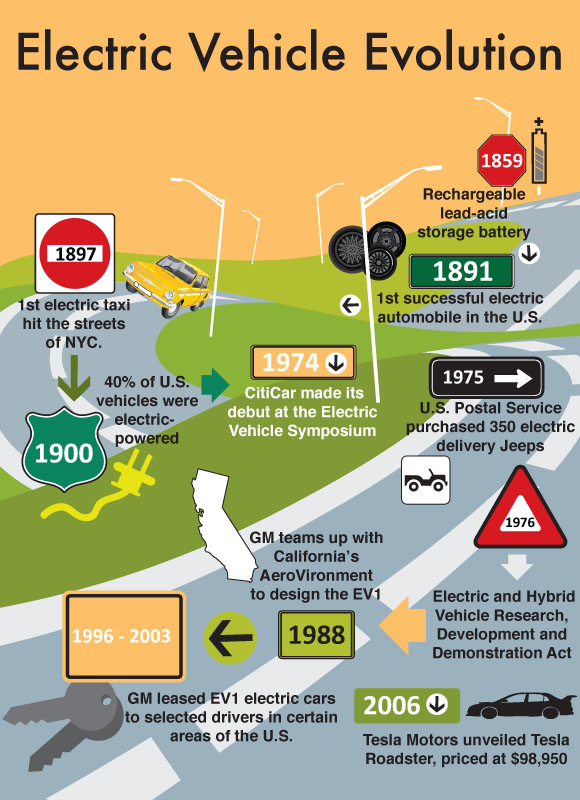
The Future of Energy Efficient Vehicles + (Infographic)

Flying cars were expected to be the future by 2000; despite erroneous expectations, cars have become radically advanced within recent years.  Cutting-edge technology has prompted the birth of the car of the future due to anxieties of energy efficiency and rising pollution.

By 2025, all new U.S. vehicles must be equipped with a 55mpg+ fuel range.  To contend with new fuel regulations, each year a car must be 5% more fuel-efficient.  The price at the pump is expected to increase 25% by 2025; presently, the average vehicle gulps an annual average of $1700.  Future hybrid & electric vehicles may cost $2400 more, but consumers will save $8200 in additional expenses.

Plug-in vehicles (PEV) or electric vehicles (EV) are gaining in popularity, but critics cite inflated prices, shortage of fueling stations, and limp technology advancements as probable disappointments. Despite the EV knockers, the Tesla Model S recently earned Car of the year for 2012 by Automobile Magazine and received Motor Trend’s Car of the Year honors in 2013.  Cadillac, BMW, Audi, and Honda are soon to follow in the EV trend in 2014.

Alternative fuels are the clean fuels of the future: liquid petroleum gas (LPG), ethanol, biodiesel, and natural gas.  LPG and natural gas are undoubtedly promising; these domestic fossil fuels yield less toxic pollutants and greenhouse gases.  Biodiesel, unlike its petroleum counterpart, originates from vegetable oils and animal fats. Corn and other domestic crops create ethanol.   The government promotes these unorthodox fuels with alluring tax incentives to qualifying consumers.

House Bill 2453 may leave an unpleasant taste in some consumer’s mouths after it is passed.  This tax, to be blunt, fines individuals to drive an electric vehicle.  This gas tax would be aimed at 2015 or later vehicles, with 55 miles/gallon or more.  A little background information: 60% of state projects are funded by taxes on gasoline.  Thus, states are collecting less tax money because of existing and future electric and hybrid vehicles.  Point blank, the fee would be 1.56 cents per mile.

These destined energy efficient vehicles could conceivably constitute 65% of the market in 2025.  Consumer demand, credits, and government incentives will determine the car dealership of the future.
energy-efficient-cars


Filed Under: Energy Efficiency Tagged With: biofuels, cars, electric car, energy, energy efficiency, energy efficiency projects, energy savings, ethanol, LPG, natural gas, propane, Tax Bill 2453, vehicles

April 29, 2013 by Kendal White

[Infographic] Reasons To Go Green

recycling-graphic

Top 10 Cleanest Countries

  1. Iceland
  2. Switzerland
  3. Costa Rica
  4. Sweden
  5. Norway
  6. Mauritius
  7. France
  8. Austria
  9. Cuba
  10. Columbia

 Types ofMost Recyclable Plastics 

  • PET or PETE (polyethylene terephthalate)
  • HDPE (high-density polyethylene)
  • PVC (polyvinyl chloride)
  • LDPE (low-density polyethylene)
  • PP (polypropylene)
  • PS (polystyrene)
  • Others


How to Recycle Plastic

  • Curbside Collection: some communities offer curbside collection of plastics for recycling
  • Bottle Banks: you can exchange plastic bottles for money in some states
  • Recycling Centers: take plastic items to be recycled


Recycling reduces the amount of plastic that ends up in landfills, decreases the amount of natural resources used to make plastic, and saves energy.


4 Reasons to Go Green

  • Endangered Animals: as many as 247 animals are on the critically endangered list as of 2008.
  • Deforestation: 8% drop in the amount of earth covered by rain forests.  Many experts suggest the rain forest will be entirely eliminated by 2050.
  • Global Warming: an increase in carbon dioxide that has led to global warming.
  • Growing Landfills: filled with trash that could take millions of years to decompose


Top 10 Polluting Countries 

  1. China
  2. United States
  3. Russia
  4. India 
  5. Japan
  6. Germany
  7. Canada 
  8. United Kingdom
  9. South Korea
  10. Iran


Filed Under: Energy Efficiency, Uncategorized Tagged With: 10 Cleanest Countries, 10 Most Polluting Countries, Deforestation, Endangered Animals, environment, green, plastics, Recycle

April 23, 2013 by Kendal White

Renewable Energy And The Crusade Towards Innovation

Renewable energy is continually replenished and non-polluting: geothermal, sun, water, and wind.  The popularity of renewable energy is growing due to high oil prices, change, government legislation, and mounting government support paired with incentives. Greenhouse gases are detrimental to the Earth’s atmosphere; these gases allow sunlight to enter the atmosphere, thus trapping heat in the atmosphere.  These rising temperatures may trigger climate change.  Greenhouse gases in North America are primarily from energy consumption due to economic growth

Solar power technologies utilize the sun’s energy to provide electricity.  Solar power supplies less than 1% of U.S energy requirements; nevertheless, solar technologies are quickly advancing.  Solar technologies used for harnessing solar energy include photovoltaic cells, passive solar designs, and flat-plate collectors. The applications used to adapt solar power into electricity are costly, yet, the substantial potential of solar energy remains.

Hydropower is the most conventional renewable energy source, and uses flowing water to produce electricity. Major dam sites in the United States include the Tennessee Valley, the Colorado River, and the Northwest.  Hydropower is suitable for supplying large electricity requirements and is the least expensive renewable energy source.

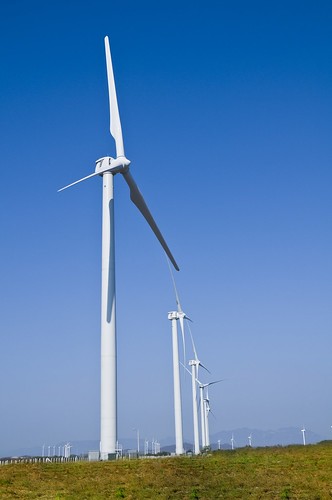
ID-10033605Wind energy applies wind turbines to generate electricity; this sector of renewable energy is the fastest growing.  Ideal placement for turbines is in an area of strong winds: Alaska, the Appalachians, and the western United States.

Geothermal energy utilizes natural sources of heat trapped beneath the Earth.  Underground hot water or steam is the conventional form of generating power.  Geothermal technologies embrace geothermal heat pumps, direct-use systems, and reservoirs.

Innovative technologies continuously attempt to improve the employment of renewable energy.

Livestock methane gas emission is a severe threat to the global climate.  In British Columbia, the Cowpower Program encourages residents to pay a slight percentage on their utility bill.  This premium will help pay for an anaerobic digester- bacteria is converted into organic material, creating energy.

Groundbreaking transportation could ease the reliance on fossil fuels for energy.  The invention of a speed vacuum train could be reality in the near future.  A speed-vac train is based upon the idea of removing the air from a sealed tub, and pressing a train through.  Conventional trains use a great deal of energy; the vacuum theory would be matched with magnetic levitation devices, allowing trains to reach 4,000 mph.

The latest in solar technology has spawned the idea of a device to trap light, which progresses the proficiency of organic solar shells by 175%.  This “black hole for light” could possibly allow for an economical, marketable solar shell.


Filed Under: Energy Efficiency Tagged With: efficiency, energy, environment, renewable

July 3, 2012 by Kendal White

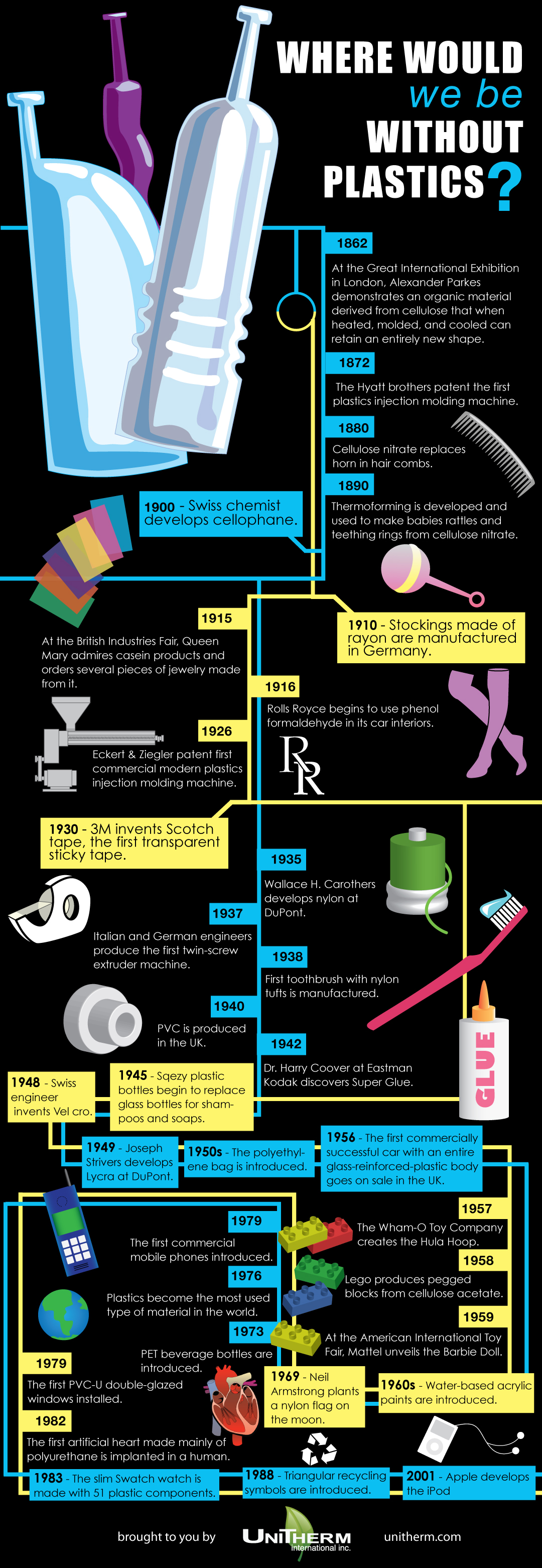
[Infographic] Where Would We Be Without Plastics?

There’s no denying that plastics are integrated into pretty much every part of our daily lives. Here at UniTherm, the plastics industry makes up a huge part of our business – so we thought it only fitting to do a little digging into the most significant advances in plastics.

Click to View Full Size

1862—At the Great International Exhibition in London, Alexander Parkes demonstrates an organic material derived from cellulose that when heated, molded, and cooled can retain an entirely new shape.

1868—Celluloid is used as a substitute for ivory in billiard balls.

1872—The Hyatt brothers patent the first plastics injection molding machine.

1880—Cellulose nitrate replaces horn in hair combs.

1890—Thermoforming is developed and used to make babies rattles and teething rings from cellulose nitrate.

1892—British chemists develop viscose silk (rayon).

1900—Swiss chemist develops cellophane.

1910—Stockings made of rayon are manufactured in Germany.

1915—At the British Industries Fair, Queen Mary admires casein products and orders several pieces of jewelry made from it.

1916—Rolls Royce begins to use phenol formaldehyde in its car interiors.

1926 – Eckert & Ziegler patent first commercial modern plastics injection molding machine.

1930—3M invents Scotch tape, the first transparent sticky tape.

1935—Wallace H. Carothers develops nylon at DuPont.

1937—Italian and German engineers produce the first twin-screw extruder machine.

1938 – First toothbrush with nylon tufts is manufactured.

1940—PVC is produced in the UK.

1942—Dr. Harry Coover at Eastman Kodak discovers Super Glue.

1945—Sqezy plastic bottles begin to replace glass bottles for shampoos and soaps.

1948—Swiss engineer invents Velcro.

1949—Tupperware made from low-density polyethylene launched in the US.

1949—Joseph Strivers develops Lycra at DuPont.

1950s—The polyethylene bag is introduced.

1956—The first commercially successful car with an entire glass-reinforced-plastic body goes on sale in the UK.

1957—The Wham-O Toy Company creates the Hula Hoop.

1958—Lego produces pegged blocks from cellulose acetate.

1959—At the American International Toy Fair, Mattel unveils the Barbie Doll.

1960s—Water-based acrylic paints are introduced.

1969—Neil Armstrong plants a nylon flag on the moon.

1973—PET (polyethylene terephthalate) beverage bottles are introduced.

1976—Plastics become the most used type of material in the world.

1979—The first commercial mobile phones introduced.

1979—The first PVC-U double-glazed windows installed.

1982—The first artificial heart made mainly of polyurethane is implanted in a human.

1983—The slim Swatch watch is made with 51 plastic components.

1988—Triangular recycling symbols are introduced.

1991—Dyson launches popular vacuum cleaner in Japan.

1994—A smart car is made with colored polycarbonate panels that are lightweight and flexible.

2001—Apple develops the iPod.

2009—Boeing nicknames a 747 “Boeing’s Plastic Dream” because 50% of the plane is made from plastic material.

Filed Under: Plastics Industry

June 6, 2012 by Kendal White

Budgeting For Energy Efficiency Projects

Budgeting for energy efficiency projectsCompanies always look to make the best decisions when selecting capital projects to work into the budget; simple metrics like Return on Investment and Internal Rate of Return tend to dictate how the budget for these projects is written each year. In an effort to increase the bottom line, investments are often times funneled toward projects and purchases that directly affect sales rather than decreasing operating costs, but sales growth is never guaranteed.
In other cases, capital projects are indefinitely suspended, forcing companies to make due with what they have until either more funding becomes available or sales increase. [Read more…]

Filed Under: Energy Efficiency Tagged With: capital projects, costing, costs, energy conservation, energy consumption, energy costs, energy efficiency, energy efficiency projects, energy efficiency system, energy management, energy policy of the united states, energy projects, energy rebate program, energy star, indefinitely, projects, rebate, sales promotion, save energy

June 1, 2012 by Kendal White

Manufacturing Matters: June 1, 2012 Weekly Wrap Up

Mainbiz, a business news source, offered tips for finding ways to save energy at virtually any business. Simple things like space heaters and soda machines add up to hefty energy costs. Where can you save energy costs in your business?

Image via Flickr - Walmart Corporate

The Sacramento Bee reports that California may be missing out on ‘green’ manufacturing jobs. While California is a leader in encouraging renewable energy, almost all green technology products are manufactured outside of the state. As a state facing double-digit unemployment, luring manufacturing back to California could help fuel the state’s economy and offer jobs to the thousands of unemployed workers.

According to The Daily Camera, Boulder is considering commercial energy-efficiency requirements as voluntary incentives have not produced the energy reduction the city hoped to achieve. The program would start with expanding current inventive programs, followed by a mandatory energy rating and reporting. Read more 

Have a Reshoring Story to Tell? IMTS and ReshoreNow.org are offering the chance to tell your reshoring story and will showcase selected stories as part of the Manufacturing Technology Drives Reshoring program. (thanks @ajsweatt for sharing this link)

Market Watch reports that the Obama administration launches $26 million multi-agency competition to strengthen advanced manufacturing clusters across the nation. “The Jobs Accelerator Challenge is one way the federal government is helping to support the manufacturing industry, a vital source of middle-class jobs,” said Secretary of Labor Hilda L. Solis. “The innovative products developed as a result of this federal grant program will help our economy maintain its global competitive advantage, while also creating jobs at home.” Read more (thanks @mfrsnews for sharing this link)

Filed Under: Energy Efficiency, Manufacturing, Plastics Industry

May 11, 2012 by Kendal White

Manufacturing Matters: 5/11 Weekly Wrap Up

The New York Times reports that manufacturing is “one of the few bright spot of the recovery, restoring 489,000 jobs since the beginning of 2010.” The article also describes geographic distinctions in growth, with half of the most manufacturing-specialized metropolitans now located in the Midwest.

Plastics News reports that in California a controversial pro-plastics lesson has been removed from a new statewide curriculum on the environment. After the EPA looked over the proposed curriculum, the section titled “Advantages of Plastic Shopping Bags” was replaced with recycling statistics in an 11th grade textbook.

image from flickr


ICIS
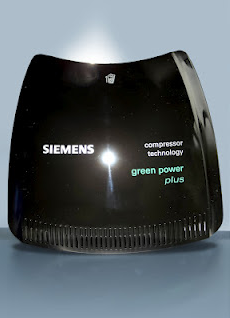
News announces that researchers at technology company Siemens have developed an alternative to ABS plastic. The new material—made with 70% renewable content—is the result of a three-year project funded by the German Research Ministry and was successfully used to make a vacuum cleaner cover.

image from icis.com


GreenBiz
examines the Sustainability Leadership List, which recognizes environmentally-conscious companies each year. But because some criticize the results, they also discuss plans for the Global Initiative for Sustainability Ratings that would develop a standardized method of measuring and ranking sustainability performance.

Plastics Today recognizes Dignity Health, the founding sponsor of the Healthier Hospitals Initiative, as one of the first hospital groups in the country to start using pigment-free patient plastics. This California-based healthcare organization is a leader in sustainability efforts to reduce hospitals’ impact on the environment by adopting innovative alternatives.


Filed Under: Manufacturing, Plastics Industry Tagged With: energy efficiency, manufacturing, plastics, plastics industry

May 10, 2012 by Kendal White

Smart Grids: Bringing Utility Systems into the 21st Century.

What is a smart grid?
Just as smart phones have evolved into multi-purpose devices that support a wide range of applications, smart grids have become a way to computerize the electric utility grid and better manage the increasing energy needs of 21st century consumers.

The “grid” encompasses all the networks that carry electricity from the plant where it is generated to the homes and office buildings where we consume it. Smartgrid.gov refers to our current grid as an “aging infrastructure” set up to handle only simple energy demands.

For the past 100 years, utility workers have had to go out to gather much of the data needed to provide electricity — reading meters, looking for broken equipment, measuring voltage, and so on. And most of the devices utilities use to deliver and manage electricity rely on manual or analog systems. Now, the electricity industry is taking great strides to modernize the process.

A smart grid system digitizes data collection and also acts on information about consumer behavior — similar to the way Google learns your online searching habits and Netflix knows your movie preferences. Each device on the network has hi-tech sensors to gather data and automation technology that allows the utility company to adjust and control each individual device or millions of devices from a central location.

In addition, a smart grid system can

  • Detect faults and isolate outages
  • Restore electricity quickly and strategically after power disturbances
  • Reduce management costs for utilities, lowering power costs for consumers
  • Reduce peak demand, which will also help lower electricity rates
  • Enable active participation by consumers in demand response
  • Integrate large-scale renewable energy systems
  • Integrate customer-owner power generation systems
  • Operate resiliently against physical and cyber attack

Who supports the smart grid?
In 2007, Congress passes the Energy Independence and Security Act, which supports the DOE in leading and coordinating a national grid system. Such a system would involve upgrading the current system or replacing it altogether. Smartgrid.gov advocates that a modern grid be constructed “from the bottom up to handle the groundswell of digital and computerized equipment and technology dependent on it.”

In 2009, the Obama administration allocated $3.4 billion in grants as part of a stimulus package to help utilities develop and implement technologies such as smart meters, digital transformers, and automated power monitoring and management systems.

We have seen smart grids deployed on a smaller scale in cities like Austin (2003) and Boulder (2008), and several areas in Europe and Canada are currently working towards large-scale smart grid systems.

Smart grids are designed to give consumers more control over their energy use. Imagine monitoring and managing electricity just as you do your bank account. Smart grids will provide a clear and timely picture of how much electricity you use and when it costs the most to run.

To learn more, download the DOE’s Smart Grid System Report, and check out unitherm.com for more ways to take control over your energy expenses.

Filed Under: Energy Efficiency Tagged With: DOE, elecricity industry, elecricity rates, electric grid, energy conservation, energy costs, energy efficiency, energy efficiency projects, energy management, power outages, renewable energy, smart grid, utility costs

May 8, 2012 by Kendal White

The Evolution of Insulation

As we grow more aware of our environmental impact—and as utility bills grow more costly—energy efficiency becomes a central concern in construction projects and building updates. LEED certifications set efficient buildings apart from the rest. Pink attic insulation doesn’t quite cut it anymore.

Natural Insulation
Although it’s a hot topic now, energy efficiency—insulation in particular—is nothing new. Since the beginning of time, the Earth and its inhabitants have found remarkable ways to regulate temperature. Atmospheric gases gather in the ozone layer, water surrounds land, mammals grow fur and store body fat, birds are born with feathers, and early on, humans discovered heat-trapping material like wool.

We have always put extra effort into shielding ourselves from the elements. Early humans built their homes out of natural insulators like grass, leaves, straw, mud, ice, and mountainsides. And landscaping wasn’t always about aesthetics—trees planted near houses provided precious shade and insulation.

While keeping extreme temperatures out, people also came up with ways to generate heat within. Some buildings in the Roman Empire and ancient Korea used empty spaces in floors and walls to conduct air heated by furnaces. By 1700, Russian engineers began developing water-based systems to circulate heat.

Synthetic Insulation
With the advent of modern heating systems came the need for better insulators. After all, gas and electric systems don’t come cheap like heat from a wood-burning furnace, and they create conditions that need to be regulated in order to work properly.

In 1930, Dale Kleist, a researcher at the Owens-Illinois Glass Company, made one of those lucky mistakes that so often leads to a monumental discovery. While trying to seal two plates of glass together, he accidentally shredded the glass into tiny fibers with a high-pressure air hose. Thus, fiberglass was born and soon found its most common form in blanket insulation.

Meanwhile, manufacturers began to realize the benefit of insulating not just their buildings but their heat sources as well. This helped protect workers and equipment, save energy, and improve overall efficiency.

Custom Insulation
We’ve come a long way since adobe huts and igloos. Today, engineers use R-values (the measure of thermal resistance) to quantify and compare the insulating capability of different materials. In this way, they can combine the most effective insulators and create premium insulation.

Visit unitherm.com to learn more about custom insulation systems.

Filed Under: Energy Efficiency, Manufacturing Tagged With: attic insulation, building engineering, efficiency, energy conservation, energy efficiency, energy management, fiberglass, insulators, thermal insulation

May 7, 2012 by Kendal White

Opportunities for Greater Efficiency in Custom Molding

As more and more manufacturers see significant energy savings after insulating their machines, insulation jackets are becoming priority number one in many energy management strategies.

UniTherm has been supplying insulation jackets in the plastics industry for over 30 years, and with each new product and custom service, UniTherm strives to address a specific processing need. With this innovative mentality, UniTherm can provide opportunities for greater efficiency, as it has with its new product called QuickCool.

QuickCool is an insulation jacket with an additional feature—it is designed to open easily so that machines can quickly cool as they are prepared for different processes. QuickCool wraps completely around the barrel and insulates as well as UniTherm’s other jackets, but it has high-temperature straps on the inside to hold it in place while the top flap opens to release heat when necessary. Otherwise, the top flap velcros tightly to the rest of the jacket to keep machines working at high efficiency with minimal heat loss. This way, barrels and heater bands are always easily accessible without having to remove the entire jacket, and machines can reach and maintain different desired temperatures as needed.

QuickCool closed to insulate

QuickCool open to release heat


Barbara Arnold-Feret, custom molding expert and new addition to UniTherm’s sales team, calls QuickCool a “flexibility enhancer.” QuickCool, she explains, “offers all the advantages of insulation along with the ability to change temperatures quickly. It allows great flexibility for molders looking to cool their machines for whatever reason, including material changes.” No longer do custom molders need to worry about insulation encumbering their access to the machines or their ability to switch processes involving different materials. “It is especially convenient when working with polyolefins and perfect for molders that make a little of everything,” says Barbara.

In fact, a custom molder with 3,000 molds running short runs with PolyPro and ABS installed QuickCool blankets on its machines and found that the product allowed them to cool from 550˚F to 350˚F in the time it took to change the mold.

UniTherm has been supplying insulation for over 30 years, and the Research and Development team continues to explore new energy-efficient solutions. They are excited to offer a product that will not only save energy but also adapt to the alternating processes in custom molding.

Filed Under: Energy Efficiency, Plastics Industry Tagged With: custom molding, custom products, custom services, energy efficiency, energy management, plastics industry

« Previous Page
Next Page »
  • English

Quick Links

MSDS
Product Brochures
Energy Study Library
Product Videos

Follow UniTherm

Facebook
Twitter
Blog
YouTube
Instagram
Pinterest

UniTherm Insulation Systems

711 Jones St.
Lewisville, TX 75057
Toll Free: 800.657.9542
Phone: 972.436.1401
Fax: 972.436.0112
info@unitherm.com

Copyright © 2026 · Executive Pro Theme on Genesis Framework · WordPress · Log in